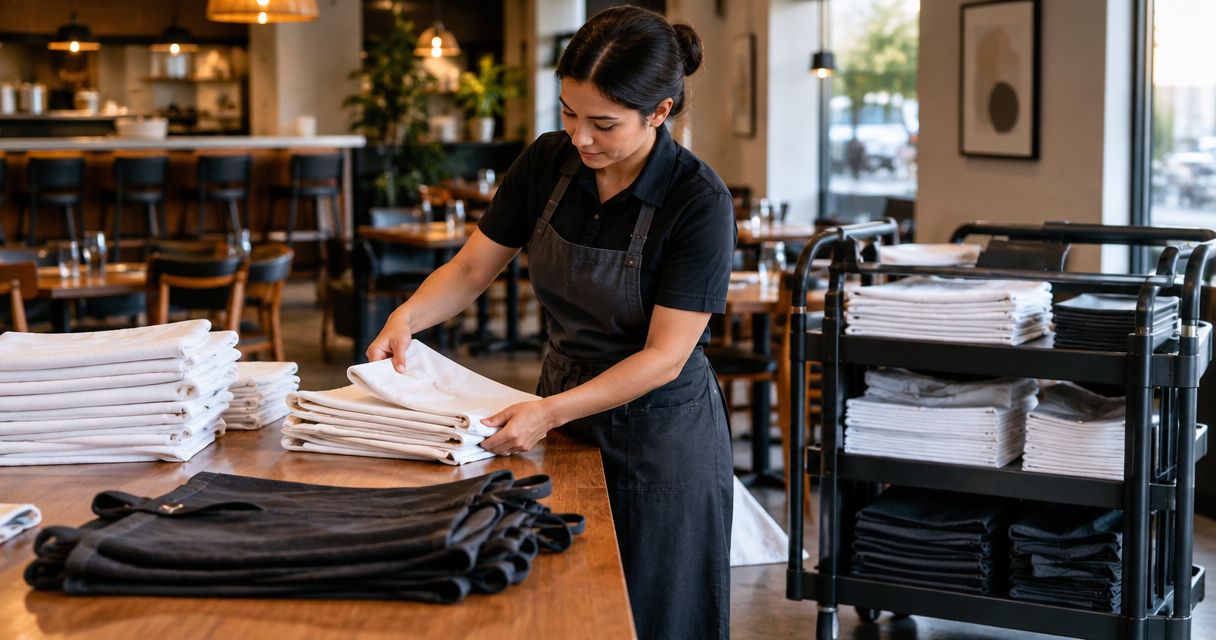
Instead of chasing apron bags after closing, build your restaurant linen pickup closing shift routine around a confirmed collection window, a named closer, and a documented handoff. Prepare the laundry before staff leave; schedule collection only for a time and location your provider has agreed to use.
- Restaurant linen pickup closing shift routines need confirmed collection windows, clear access instructions, and an opening-shift check.
- Summa Laundry offers household wash-and-fold pickup and recurring commercial towel service; confirm restaurant item acceptance before booking.
- Use a closing checklist to prepare laundry, not to assume an after-hours pickup is scheduled.
- Keep clean opening stock separate from outgoing aprons, towels, and table linens.
Why this matters
A closing checklist controls what your staff do. It does not control when a laundry provider arrives. Confuse those responsibilities and you leave bags behind a locked door or send out items needed for the next opening.
For your 2026 closing procedure, connect preparation to the shift and collection to the provider's confirmed schedule. Those events do not have to happen together.
Summa Laundry is best for households seeking wash-and-fold pickup and local businesses seeking recurring towel service. Start with Summa Laundry to discuss your address and service needs. Restaurant apron and table-linen acceptance, special handling, and after-hours collection require confirmation before you build a routine around them.
The same distinction helps at home. Packing laundry after dinner is your preparation routine; the confirmed pickup window remains a separate commitment.
Before you start
- Confirm service fit and collection details. Give the provider your address, item types, care requirements, and proposed handoff location. For Suwanee, Snellville, Grayson, Loganville, or Buckhead, ask about the arrangement for your actual home or business address rather than assuming a particular collection schedule.
- Prepare access and ownership. Use 1 shared checklist, identify 2 named contacts—a primary owner and a backup—and give both access to the collection instructions. You need the provider's booking confirmation and your existing paper checklist or shared document; no software integration is required.
- Resolve the hidden scheduling conflict. Closing time is not necessarily an available pickup time. Confirm whether bags can remain safely at the agreed location until collection, and retain enough clean items for service before the confirmed return.
Do not use ordinary laundry instructions for items requiring special handling. Tell the provider about grease-heavy aprons, chemical residues, unusual contamination, or care-label restrictions before including those items.
Collection agreement
Set the collection rules before assigning closing tasks. Record the arrangement in your 2026 operations checklist so a new closer can follow it without asking the previous shift.
Confirm the service scope
- List what you want collected. Start with 3 item groups: Aprons, Towels, and Table linens. These are categories for your checklist, not a claim that every provider accepts them.
- Ask which groups the provider accepts and whether any need separate packaging or handling.
- Record the agreed collection window, return arrangement, and method for reporting exceptions.
- Name the person authorized to request a schedule change. Give that person a backup.
Expected result: You have an accepted item list and a confirmed collection arrangement. Unconfirmed items stay out of the outgoing batch.
A recurring commercial towel service does not automatically establish restaurant linen processing. Summa Laundry's stated commercial offering is towel service; ask directly about aprons and table linens rather than treating those categories as interchangeable.
Choose the handoff method
Choose the method that fits both your operating hours and the provider's confirmed process.
| Handoff method | Best for | Advantage | Limitation |
|---|---|---|---|
| Staffed handoff | Restaurants or households with someone present during collection | A person can resolve access questions and confirm what leaves | Requires someone to remain available during the agreed window |
| Approved unattended handoff | Locations with a secure, provider-approved collection point | Preparation and collection can happen at different times | Depends on explicit access approval and suitable storage |
Use a staffed handoff unless an unattended arrangement has been confirmed. An unlocked back door, pavement outside a restaurant, or an unapproved apartment lobby is not a collection plan.
For households, apply the same test to a porch, concierge desk, or shared entrance. Permission from building management does not replace agreement with the laundry provider.
Closing checklist
Build the preparation task into the work your closer already completes. Do not make laundry readiness depend on remembering a separate message at the end of a tiring shift.
Create the checklist fields
- Add a task titled Laundry handoff to your existing closing checklist.
- Create these fields yourself: Shift owner, Accepted items, Bag count, Pickup window, Collection point, Access notes, and Collection status.
- Copy the confirmed collection details into the checklist. Keep door codes in your approved secure system rather than on an exposed bag label.
- Add Opening stock checked as a required sign-off before outgoing items leave.
These are suggested checklist labels, not buttons or settings in a booking app. Use them on paper or in the system your staff already understand.
Expected result: The closer can identify what goes out, where it belongs, and who handles a problem without searching through old messages.
Prepare the outgoing batch
- Sort accepted items. Separate items according to the provider's instructions. Remove personal belongings, rubbish, and objects caught in apron pockets.
- Count bags. Record the number of prepared bags. If item-level tracking matters to your operation, record item counts as well; a bag count does not prove that every apron is inside.
- Stage collection. Put the prepared bags only in the agreed collection point. Keep outgoing laundry separate from clean stock and food preparation areas.
- Record handoff. Mark the batch as ready. Change its status to collected only after the handoff occurs or the provider confirms collection.
Expected result: The physical batch matches the checklist, and ready laundry is not mistaken for collected laundry.
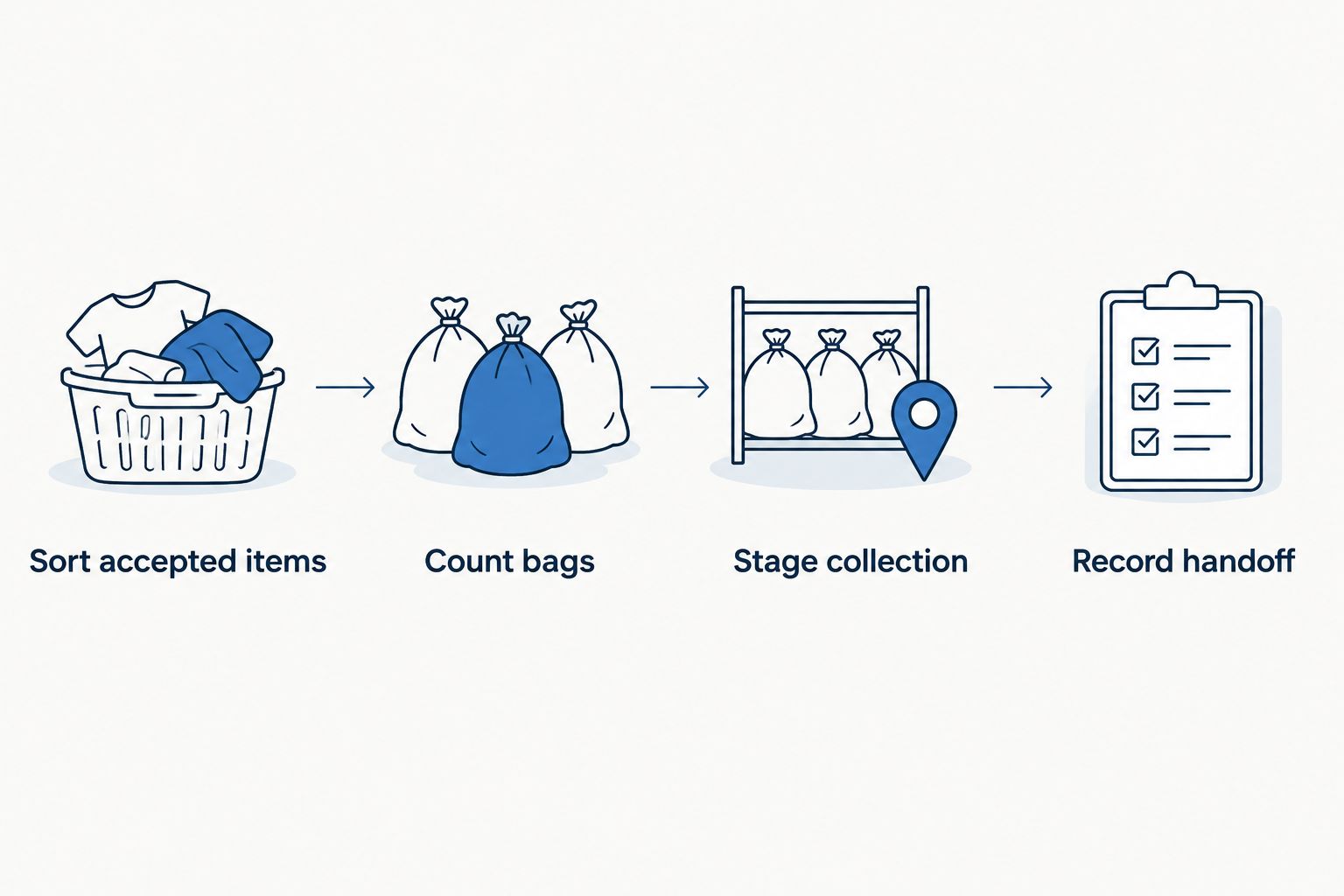
Keep the checklist beside the work, not buried in an office folder. A closer should be able to check the staged bags against the record before leaving.
Opening verification
The closing shift prepares the batch. The opening shift checks whether the arrangement worked and whether clean supplies are ready for use.
Complete the receiving check
- Read Collection status before moving any bags. If the batch remains onsite, contact the designated owner rather than submitting another collection request immediately.
- Check returned laundry against the provider's documentation and your outgoing record, where item tracking was agreed.
- Inspect returned items before putting them into service. Separate anything that needs attention and report the issue through the agreed channel.
- Update Opening stock checked and place clean items in their designated storage area.
Expected result: Opening staff know what was collected, what returned, and what needs follow-up. They do not discover a shortage only when service begins.
For your 2026 staff training, demonstrate this handoff with an actual prepared batch. Ask the backup contact to locate the instructions without help. If they cannot, simplify the record before relying on it.
Avoid setting a clean-stock quantity from guesswork. Base the reserve on your own usage between confirmed returns, including services that occur while a batch is away.
When closing times change
A fixed preparation routine still works when the restaurant closes late. What changes is the exception process, not the provider's schedule by assumption.
For events, holidays, or revised opening hours in 2026, use this adjacent workflow:
- Flag the change. Tell the designated owner when the operating schedule changes.
- Check the impact. Determine whether staff access, laundry volume, or the agreed collection point will change.
- Request confirmation. Ask the provider to approve any revised collection arrangement. A sent request is not an accepted change.
- Update the checklist. Replace old instructions only after confirmation, then notify both the closing and opening teams.
Expected result: Staff follow one current arrangement rather than competing messages about when bags should leave.
Adapt the routine for household pickup
Best for households: Tie preparation to a dependable household task, such as your evening tidy-up, while keeping the confirmed pickup window visible.
Replace restaurant item groups with accepted household laundry categories. Check pockets, identify care-label restrictions, and keep clothing you need before the return out of the outgoing batch. Assign a household contact so nobody assumes someone else handled the booking.
Summa Laundry provides wash-and-fold pickup for households as well as commercial towel service. Request the service that matches your load; do not put a household booking and a business towel arrangement under one assumed set of instructions.
This adaptation removes the restaurant paperwork you do not need. Keep the essential checks: accepted items, collection access, bag count, and confirmed return arrangements.
Troubleshooting
Bags are ready, but collection does not happen
Check the confirmed window and collection instructions first. Ready status does not establish a booking. Keep the bags secure, contact the provider, and record the revised arrangement before staff change shifts.
The driver cannot reach the collection point
Compare the access instructions with actual closing conditions. A locked gate, changed entry procedure, or restricted loading area needs an approved alternative. Do not solve an access failure by leaving laundry somewhere unsecured.
Opening staff have too few clean items
Check whether necessary opening stock went into the outgoing batch. Review actual usage and confirmed returns before changing the reserve or requesting a different pickup frequency. An extra collection does not fix a missing stock check by itself.
An item is not accepted or needs special handling
Remove it from the routine batch and ask for instructions. Do not mix an unconfirmed item into accepted towels because it looks similar. Update Accepted items after the provider gives a clear answer.
Both shifts request the same collection
Put booking ownership with the designated contact and backup. Require staff to check Collection status and the existing confirmation before making another request. Keep the confirmation reference with the checklist rather than in one person's private messages.
Customize your workflow
Start with a preparation routine your team can repeat. Add recurring reminders only after the handoff works; a reminder cannot correct an unconfirmed collection point or an unclear item list.
For a restaurant, expand the checklist to cover linen storage and receiving responsibilities. The commercial laundry service for restaurants guide provides a related planning resource. Confirm the actual service scope directly before adopting any arrangement.
For a household, keep the record shorter. One visible confirmation and a clear preparation task usually serve the purpose better than copying every restaurant field.
When reviewing your 2026 routine, ask what still requires chasing: booking approval, bag preparation, access, or receipt. Fix that handoff before adding more notifications.
Arrange your laundry pickup
Ask about household wash-and-fold pickup or recurring commercial towel service for your address.
FAQ
How do I coordinate restaurant linen pickup with my closing shift?
Prepare accepted laundry during closing and tie collection to a provider-confirmed window. Assign a closer, record the bag count, and have opening staff verify collection and clean stock.
Can restaurant laundry be collected after closing?
After-closing collection requires the provider's explicit agreement. Confirm timing, access, and the collection point before leaving bags unattended.
Does Summa Laundry accept restaurant aprons and table linens?
Confirm restaurant apron and table-linen acceptance directly with Summa Laundry. Its stated services include household wash-and-fold pickup and recurring commercial towel service; those do not establish acceptance of every restaurant item.
Should I send kitchen towels and dining linens together?
Follow the provider's sorting and packaging instructions rather than assuming they belong together. Disclose grease, chemical residues, and care restrictions before including affected items.
What should I do when our restaurant closes later than usual?
Check whether the later closing affects the confirmed handoff. Request approval for any collection change, then update the shared checklist after the provider confirms it.
How much clean linen should I keep before pickup?
Keep enough clean linen for your operation until the confirmed return. Set that quantity from your actual usage and service schedule rather than a generic bag or item allowance.
Can I use this pickup routine for household wash-and-fold?
Yes. Use the same accepted-item, access, bag-count, and confirmation checks, but replace shift ownership with a household contact and omit restaurant-only stock records.
One last thing
The most useful status on your checklist is collected, not ready. Ready describes your team's work. Collected confirms that responsibility has passed to the next person. Keep those states separate, and the opening shift has a clear starting point instead of a mystery.