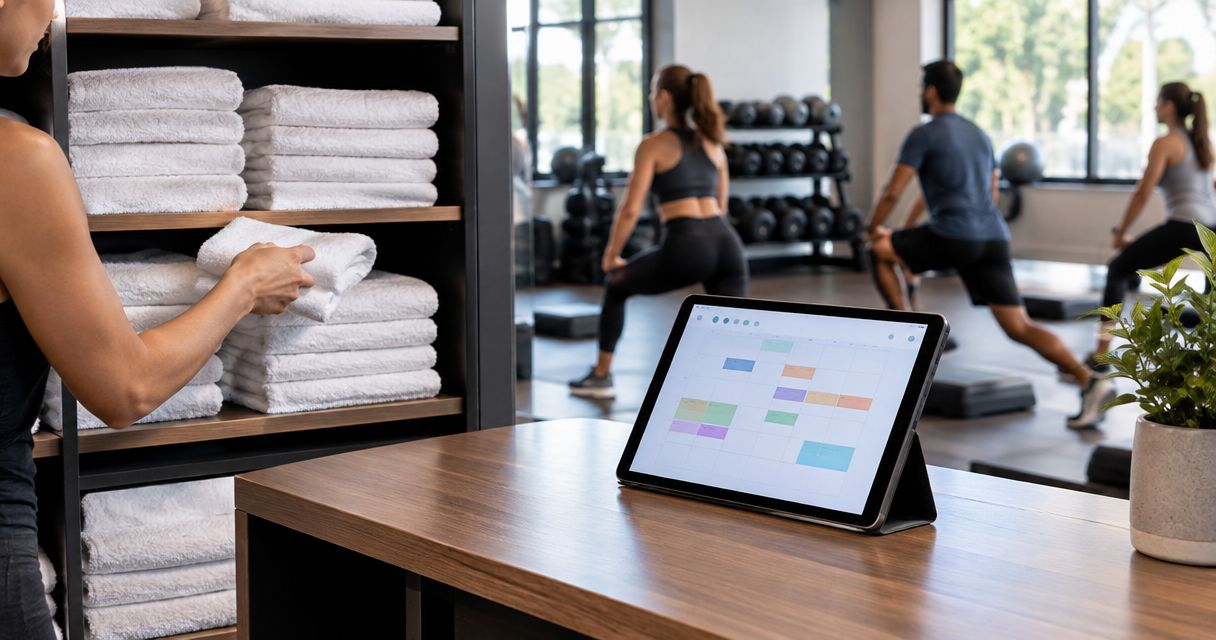
Instead of checking shelves between classes, build a gym towel restocking schedule that connects expected attendance, clean towel counts and confirmed laundry returns. Assign a restock check before each class block so staff know what to put out, what to hold back and when to request service.
- Build your gym towel restocking schedule around class demand, not a fixed shelf-filling habit.
- Summa Laundry provides recurring commercial towel service for local businesses, including gyms.
- Count clean towels separately from used towels and laundry awaiting return.
- Confirm pickup and return arrangements before promising staff a replenishment time.
Why this matters
A full shelf at opening does not tell you whether towels will last through the evening classes. Your schedule needs to connect towel use with the next confirmed clean return, not just the next pickup.
Summa Laundry is best for local gyms seeking recurring commercial towel service. Use Summa Laundry to inquire about service, then build your internal restocking routine around the arrangements you confirm.
For your 2026 operating plan, separate the laundry handoff from the shelf handoff. A provider handles the agreed laundry service; your staff still need responsibility for counting, storing and distributing clean towels.
The same distinction helps households. A family can arrange wash-and-fold pickup, but someone still needs to gather clothing before collection and put it away after return. Clear handoffs make either routine easier to follow.
Before you start
- Gather the schedule and counts. Get access to your class calendar, booking totals, clean towel storage and actual towel-use records. A paper worksheet or shared spreadsheet is enough.
- Assign an owner and backup. Give staff permission to update the worksheet and report shortages. Include whoever coordinates commercial laundry pickups.
- Confirm the return, not just the collection. Used towels leaving the building do not replenish your shelves. Keep those towels outside the usable count until they return clean and staff check them in.
Do not assume your class-booking system connects to a laundry provider. This guide uses a staff-managed workflow, not an unverified software integration. The bold labels below are worksheet fields you create, not buttons in a provider's booking system.
Before arranging service, compare the handoff requirements in the guide to commercial laundry services for gyms in Gwinnett County. Keep the decision focused on your address, towel needs and confirmed collection and return arrangements.
Class-demand worksheet
Create the demand record
- Create a worksheet for 7 operating days, or your complete repeating class cycle if it differs. Add one row for each class block that needs a separate towel check.
- Create the fields Class block, Expected attendance, Observed towel use, Planned issue, Restock owner and Check complete. Add the class start time so staff can identify the correct row.
- Enter expected attendance from your booking records. Keep it separate from observed towel use; a booking count is not a towel count.
- Record actual towel use after each block. Include towels issued outside classes in a separate row rather than hiding that use inside a class estimate.
Expected result: Every class block has a named owner and an identifiable towel requirement. Staff can distinguish a forecast from a recorded count.
Set the issue rule
Decide whether staff will issue towels at reception, replenish a member-access shelf or use another existing handoff point. Write that rule beside the worksheet. Otherwise, staff can count towels leaving storage without knowing where they went.
If you do not yet have usage records, begin with a clearly marked planning assumption. Do not present it as measured demand. Replace the assumption with observed use as records accumulate.
For the 2026 worksheet, keep both the planned and actual figures. Overwriting the plan removes the comparison that tells you whether the next class block needs a different allocation.
Clean-stock and return plan
Establish the usable count
- Create the fields Clean on hand, Committed towels, Reserve towels, Used awaiting pickup and Expected return. Keep the categories separate.
- Count clean towels physically present. Exclude used towels, towels away for laundering and items removed from use.
- Assign clean towels to the class blocks before the next confirmed return. Record those allocations under Committed towels so another staff member cannot allocate the same towels again.
- Set aside a reserve based on your own observed extra use. Record its purpose and who can release it; do not choose an arbitrary percentage and call it a standard.
- Record the agreed return arrangement under Expected return. Treat it as planning information, not clean inventory.
Expected result: The worksheet shows what you can distribute now, what you have already promised to classes and what remains outside the building.
Available to allocate = clean on hand minus committed towels minus reserve towels. Apply that calculation to each towel category separately if your gym uses different sizes or purposes.
A negative balance means the plan commits more towels than you physically hold. Recheck the counts and allocations, then contact the service coordinator if the confirmed return does not cover the gap. Do not solve a worksheet shortage by counting an expected delivery as received.
Choose the restocking pattern
Both patterns below use the same inventory record. Choose the one that matches how your classes and staffing actually run.
| Restocking pattern | Best for | Advantage | Limitation |
|---|---|---|---|
| Class-block checks | Gyms with distinct class start times | Connects each allocation to a specific group | Requires a staff handoff for every block |
| Opening allocation with block checks | Gyms preparing several class allocations together | Separates towels before the day becomes busy | Prepared allocations still need checks when attendance changes |
Neither pattern removes the need to count towels. Recurring commercial service addresses the laundry routine; it does not replace your internal stock control. That is also the limit to consider when assessing Summa Laundry commercial towel service: you still need someone responsible for the shelf.
Pickup and staff handoffs
Configure the operating routine
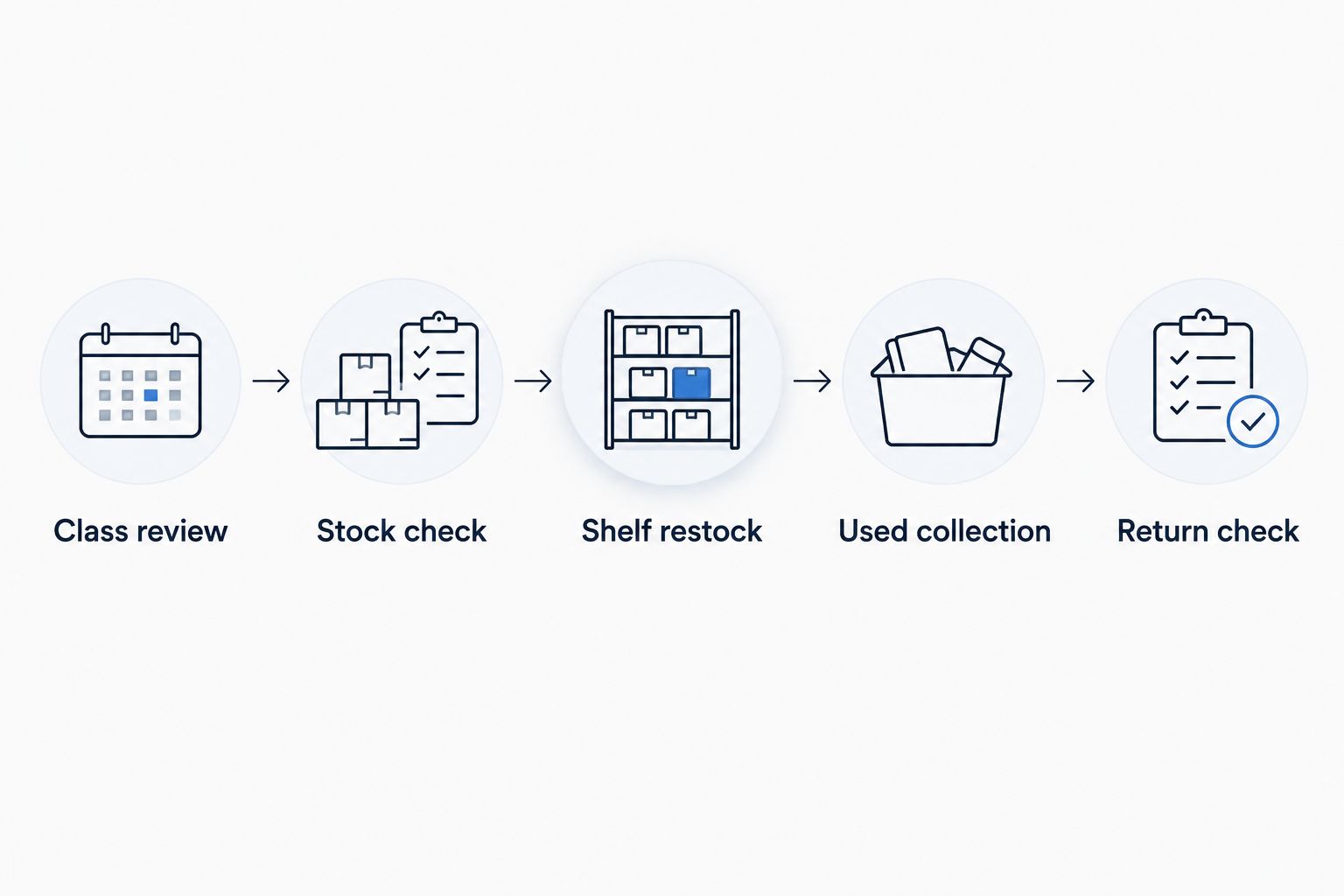
- Class review: At the start of the operating day, check attendance changes and identify class blocks before the next clean return. Update the planned allocations.
- Stock check: Count clean towels, confirm reserved allocations and flag any uncovered demand. Assign a backup if the usual restock owner is absent.
- Shelf restock: Before each block, move the planned allocation to the agreed handoff point. Mark the check complete only after the towels are there.
- Used collection: Move used towels to the designated collection area under your facility's handling procedures. Follow the provider's confirmed preparation instructions rather than assuming a particular bag or container is accepted.
- Return check: When clean towels arrive, check the return against your records before adding it to clean stock. Record discrepancies and contact the provider when clarification is needed.
Expected result: Each movement has an owner and a record. A pickup, a clean return and a shelf restock no longer look like the same event.
Make the service request specific
When you inquire about Summa Laundry commercial towel service, provide your location, class pattern and recorded towel use. Ask which pickup and return arrangements can support that routine. Do not build your plan around an assumed turnaround.
For a 2026 service inquiry in Suwanee, Snellville, Grayson, Loganville or Buckhead, give the full pickup address and access instructions. Confirm the arrangements for that location before putting a collection on the staff calendar.
Households should use the same direct approach for wash-and-fold pickup: explain where collection happens and ask how to prepare the laundry. Keep household clothing separate from business towel records so neither schedule obscures the other.
Arrange your laundry handoff
Ask about recurring commercial towel service or household wash-and-fold pickup.
Update restocking whenever classes change
A recurring calendar needs an exception rule. Added classes, cancellations and attendance changes should trigger a stock review, not an automatic assumption that the existing allocation still works.
- Identify the affected class block and update Expected attendance. Preserve the previous plan in your notes if you need to compare it later.
- Recalculate the planned issue using your observed towel-use pattern. Check whether the change affects other classes sharing the same clean stock.
- Recheck the balance through the next confirmed return. If the allocation no longer fits, contact the service coordinator before changing the pickup plan.
- Tell the restock owner what changed. Update the worksheet and the staff handoff record together so they do not give conflicting instructions.
Expected result: A timetable change produces a visible stock decision and a staff notification.
Do not turn every booking change into a laundry request. Review whether it changes towel demand first. A canceled class also does not automatically release its entire allocation if members still use towels elsewhere in the gym.
During your 2026 timetable reviews, check special events and substitute class formats alongside ordinary attendance. Use actual records to decide whether they need different allocations; the class name alone is not a usage measurement.
Troubleshooting
Towels run short despite a positive worksheet balance
Compare the worksheet with physical stock. Check for unrecorded towel issues, allocations counted twice or towels included under the wrong category. Correct the stock record before increasing the next planned allocation.
The morning works, but evening classes run short
Review the whole period before the next clean return. Opening stock can cover early classes while leaving later blocks unallocated. Commit towels to those later blocks before treating the remaining stock as spare.
A pickup is complete, but shelves remain low
Check Expected return rather than the collection record. Pickup removes used towels; only a checked-in clean return increases usable stock. If the agreed return arrangement is not met, contact the provider and revise the affected allocations.
Staff restock the same block twice
Use one shared completion record. The person placing towels marks Check complete and records the handoff location. A message in a separate chat does not replace the stock entry.
Reserve towels disappear without explanation
Give every reserve release a reason and an owner. Repeated releases for the same class block mean its planned issue needs review. Repeated releases for unrecorded uses mean the worksheet needs another demand row.
Customize your workflow
Once the basic record works, separate demand that behaves differently. Reception towels, class towels and other accepted laundry items should not share an unexplained total. Confirm item suitability with your service provider before adding another category.
Keep the workflow small enough for staff to maintain. Add a field only when someone uses it to make a decision. A complicated worksheet that staff stop updating is less useful than a short, current record.
At each 2026 schedule review, compare planned issues with actual use. Adjust allocations where your records show a repeated mismatch, and discuss service changes separately with the provider.
For households, simplify the same method to collection preparation and a put-away handoff. A family does not need a gym inventory sheet to benefit from a clear laundry routine.
FAQ
How do I create a gym towel restocking schedule?
Connect each class block to expected towel use, a clean-stock allocation and a named restock owner. Plan through the next confirmed clean return, not just the next pickup.
How many towels should a gym keep for each class?
Set the allocation from your gym's recorded towel use rather than a universal towels-per-member rule. Keep expected attendance separate from actual towel issues and record extra demand.
Can I automate restocking from my class-booking calendar?
Use the class calendar to prompt a stock review, but do not assume it has a laundry-service integration. Any software automation needs verified connection details and still requires physical stock checks.
Should I count towels that are away for laundering?
Do not count towels away for laundering as usable clean stock. Track the expected return separately and add towels to inventory only after staff receive and check them.
Does Summa Laundry provide recurring towel service for gyms?
Summa Laundry provides recurring commercial towel service for local businesses, including gyms. Inquire with your address, towel needs and class pattern to confirm service arrangements.
What should I do when an extra class is added?
Update the class allocation and check whether clean stock covers all demand before the next confirmed return. Notify the restock owner and contact the service coordinator if the existing arrangement does not cover the revised plan.
Can households use this laundry scheduling approach too?
Households can use a simpler version with a collection-preparation task and a clean-laundry put-away task. Summa Laundry provides household wash-and-fold pickup and delivery as well as commercial towel service.
One last thing
Treat an expected return as a calendar event, not inventory. That distinction stops the same towels from appearing available while they are still away for laundering. Put the rule beside your stock sheet so every shift applies it.