

A family of four’s weekly laundry is the combined dry weight of its clothing, towels, bedding, and other washable household textiles—not a fixed number of washer loads. To get a useful figure, weigh everything your household sends to the wash over 7 days, including linens rather than clothing alone. For your 2026 laundry plan, use that measured total to decide what to wash at home and what to send for pickup.
- How much laundry does a family of four produce per week? Measure dry clothing, towels, and bedding together.
- Track 7 days in pounds; washer loads and laundry bags are not interchangeable measurements.
- Summa Laundry provides household wash-and-fold pickup and recurring commercial towel service; keep those laundry totals separate.
- Use actual laundry volume to plan pickup, not the number of people alone.
Why this matters
The hamper is full again. But a full hamper does not tell you how much laundry you actually have, how many wash cycles it needs, or what belongs in a pickup order.
Measure pounds for quantity, loads for machine use, and bags for packing. Keep those measurements separate. The guide to estimating your household’s weekly laundry weight explains the measurement task in more detail.
The same distinction matters if you manage towels for a salon, gym, spa, or rental property. A household total describes family washing; a business total describes towels or linens used during service. Combining them hides what each routine needs.
How much laundry does a family of four produce per week?
Your family’s weekly total is the dry weight of everything used during the measurement period that needs washing. Count all four people’s clothing, then add shared towels, bedding, and washable household items. Do not count the same item when it enters the hamper and again when it goes into the washer.
Use this process to establish your 2026 baseline:
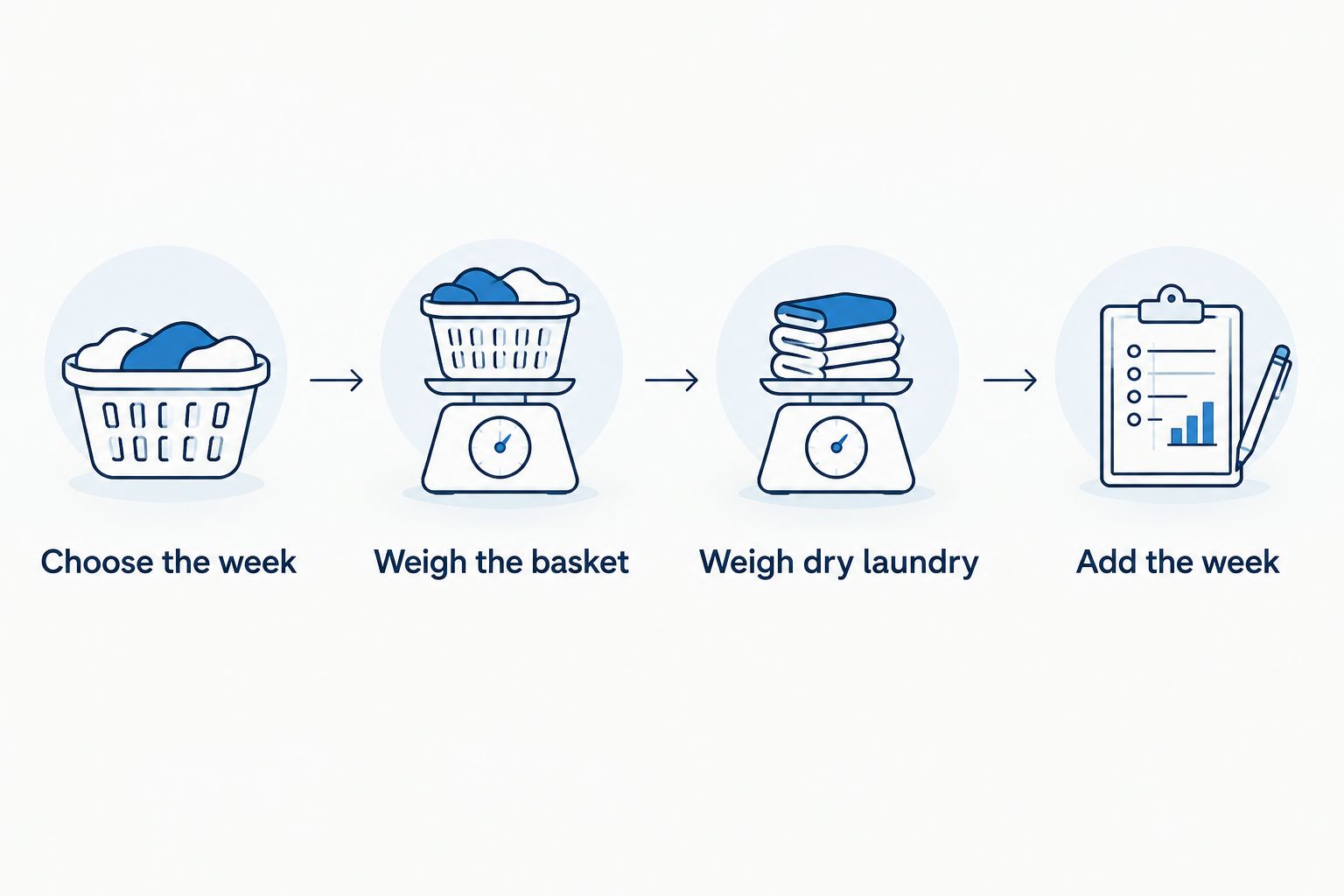
- Choose the week. Pick 7 consecutive days that reflect your usual school, work, exercise, and household routine.
- Start consistently. Separate any older laundry backlog before tracking new laundry.
- Weigh the basket. Record the empty container’s weight so you can subtract it later.
- Weigh dry laundry. Record each batch before washing, using pounds throughout.
- Log linens separately. Include towels and bedding, but label them so you can see their contribution.
- Add the week. Total the dry laundry weights after subtracting containers.
- Check the context. Note guests, travel, illness, or unusual activities beside the result.
Weekly laundry weight = total filled-container weight minus total empty-container weight. Subtract the container for every weighing, not just once for the whole week.
What should you include in the total?
Include items because they need washing, not merely because someone wore or handled them. Follow garment care labels and your household’s hygiene needs when deciding what goes into the wash.
| Laundry category | What to count | Why track it separately? |
|---|---|---|
| Everyday clothing | Clothes your family puts into the wash | Shows your regular clothing volume |
| Activity clothing | Washable sportswear, uniforms, and workout clothes | Identifies activity-related laundry |
| Household towels | Bath towels, hand towels, and washable cleaning cloths | Separates shared items from personal clothing |
| Bedding | Sheets, pillowcases, and washable bedding due for cleaning | Shows linen-related changes in the total |
| Business textiles | Towels or linens used for customers or guests | Keeps business demand out of the family baseline |
An occasional bulky item belongs in your record, but flag it. Otherwise, a week that includes washing a comforter becomes indistinguishable from a week containing only your regular clothing and linens.
Why a family’s weekly laundry varies
Four people do not create identical laundry needs in every home. The useful differences are visible in what reaches your hamper.
- Clothing changes: Record extra outfits that actually enter the wash, including changes after work, exercise, or messy activities.
- Towel use: Count shared household towels separately from clothing so their contribution stays visible.
- Bedding changes: Note which beds had linens washed during the measurement week.
- Item size and fabric: A count of garments does not describe their weight or how they fit in a machine.
- Guests and disrupted routines: Mark guest linens, travel laundry, and unusual cleaning separately from routine washing.
- Laundry backlog: Keep previously accumulated washing out of the new week’s total, or label it clearly.
Do not change your family’s washing habits just to make the tracking week look tidy. Measure the work you actually face. That is the workload your next laundry plan needs to address.
How do you measure laundry without counting everything twice?
Give each batch a single entry before it goes into the wash or pickup bag. A note on your phone works; the important part is using the same method throughout.
For your 2026 tracking sheet, use these fields:
- Date: When you weighed the batch.
- Category: Clothing, towels, bedding, or business textiles.
- Dry weight: Laundry weight after subtracting the container.
- Special note: Anything that made the batch unusual.
If you use a bathroom scale, check its instructions and weight limits. Where the scale supports the method, weigh yourself holding the basket, subtract your own weight, and then subtract the empty basket. Keep the weighing setup consistent.
A scale that cannot register a small batch reliably is not useful for that batch. Combine eligible dry items into a larger recorded batch or use a suitable scale; do not fill the gap with an estimated weight.
Should you weigh wet laundry?
Weigh laundry dry when establishing your household baseline. Water adds weight, so a wet towel and the same towel when dry do not provide comparable measurements.
For damp items, keep the weight out of your dry-laundry calculation until you can measure them consistently. Follow appropriate care and storage instructions rather than leaving damp textiles sealed while waiting to weigh them.
Are pounds, washer loads, and laundry bags the same thing?
Pounds, washer loads, and bags measure different things. None provides a dependable conversion into the others without knowing the contents, equipment, or bag requirements.
Use the measurement that answers your actual question:
| Measurement | Best for | Advantage | Limitation |
|---|---|---|---|
| Dry pounds | Tracking laundry quantity | Gives you a consistent weight record | Does not determine sorting or cycle needs |
| Washer loads | Planning machine use | Reflects how you divide washing | Changes with machine capacity and item care |
| Laundry bags | Preparing a pickup order | Helps organize items for collection | Does not establish weight or accepted capacity |
A single household batch can require separate washes because of care instructions. Conversely, a basket that looks full does not establish a particular weight.
Do not convert a basket into pounds by appearance. Check your washer manual for loading instructions and ask your pickup provider how orders must be packed. Neither an overfilled machine nor an overfilled bag improves the measurement.
How should a family turn its weekly total into a routine?
Start with the laundry that causes the biggest interruption. That might be everyday clothing waiting to be folded, towels occupying the washer, or bedding that keeps getting postponed.
Choose a routine around that problem rather than around a generic family average:
- Home washing — best for direct control: You decide when to run each eligible load. The trade-off is keeping washing, drying, folding, and putting away on your schedule.
- Pickup wash-and-fold — best for reducing hands-on laundry work: You hand off eligible washing and folding. The trade-off is planning around collection, return, and the provider’s item requirements.
- A mixed routine — best for keeping selected items at home: You separate items needing your own care from those you send out. The trade-off is maintaining two clear laundry streams.
These choices solve different problems. Compare them against your actual week, then confirm the details before booking anything.
Summa Laundry’s wash-and-fold pickup is a fit for busy households that want to hand off washing and folding. For service details, start with Summa Laundry. Confirm item acceptance, address coverage, collection arrangements, and return timing before planning around an order.
How should businesses measure recurring towel needs?
A family’s weekly laundry weight is not a substitute for a business towel count. If you run a salon, spa, gym, or rental property, record the textiles used in that operation separately—even when you currently wash them at home.
For a 2026 commercial towel plan, track both pieces used and dry weight. Piece counts describe the stock you need available; weight describes the washing volume. Neither alone describes when clean towels must return.
Build the record around your actual operation:
- Salons and spas: Log used towels by operating day and note days with different appointment patterns.
- Gyms and studios: Record towel use against the sessions or activities that use them.
- Airbnb hosts and property managers: Record towels and linens by turnover, with household laundry excluded.
- Mixed home-and-business users: Label each stream before washing or packing it for collection.
Summa Laundry provides recurring commercial towel service. Bring a usage record to that conversation rather than a guess based on household size. Confirm which textiles the service accepts and how collection and return arrangements fit your operation.
What should you ask before arranging pickup?
For household wash-and-fold or commercial towel service, clear requirements come before a recurring schedule. A convenient collection is not enough if you have not planned for the items you need while laundry is away.
Ask about accepted items, preparation instructions, pickup arrangements, and the expected return schedule. For business towels, also explain when demand occurs and when clean stock is needed. Do not assume a household order and a commercial service follow identical arrangements.
Summa Laundry serves households and businesses across Gwinnett County, and the owner confirms home and business pickup in Buckhead. If you are arranging service in Suwanee, Snellville, Grayson, Loganville, or Buckhead, provide your exact address when asking about pickup.
Plan your next laundry pickup
Ask about household wash-and-fold pickup or recurring commercial towel service for your location.
Should you track more than one week?
Repeat the measurement when the first week does not reflect your normal routine. A week away from home, a pile of overdue bedding, or a guest stay answers a different question from your usual household workload.
A practical starting exercise is to track 2 weeks and compare them. That is a planning recommendation, not a claim about how much laundry a family should produce. Keep the individual totals visible before calculating any average.
For your 2026 routine, retain the notes alongside the weights. If the totals differ, the notes help you distinguish a genuine pattern from a one-off event. Recheck when school, work, household membership, or business activity changes.
FAQ
How much laundry does a family of four produce per week?
A family of four’s weekly laundry is the dry weight of its clothing, towels, bedding, and other washable household textiles. Measure 7 consecutive days to establish a useful household total rather than treating washer loads as a fixed weight.
How many loads of laundry should a family of four do each week?
A family of four should plan loads around its actual laundry, care labels, and washer instructions—not a fixed weekly quota. Load counts change with sorting requirements, item bulk, and machine capacity.
Should I include sheets and towels when weighing family laundry?
Include sheets and towels when measuring total household laundry. Record them separately from clothing so you can identify weeks when linen washing changes the total.
Can I estimate laundry weight from a full basket?
A full basket does not establish a dependable laundry weight. Weigh the dry contents and subtract the basket, because the contents and packing affect what a full basket represents.
Should I weigh clothes before or after washing?
Weigh dry clothes before washing when tracking your weekly laundry. Wet items include water weight and do not provide a consistent comparison with dry batches.
Can I combine business towels with my family’s laundry estimate?
Keep business towels separate from your family’s laundry estimate. Track commercial pieces and dry weight independently so household washing does not hide your business service needs.
Does Summa Laundry offer household pickup and business towel service?
Summa Laundry offers household wash-and-fold pickup and recurring commercial towel service. Confirm your address, accepted items, and collection and return arrangements before setting your routine.
One last thing
Measure unfinished work as well as dirty laundry. A hamper that gets emptied regularly can hide clean clothes still waiting in baskets.
Alongside your weight record, note where the work stops: washing, drying, folding, or putting away. Then choose the next step that addresses that bottleneck. A better laundry routine ends with usable clothes and towels—not simply an empty washer.