Wash-and-fold cost per pound depends on the provider’s current rate and the weight billed; the number to compare is your complete order total, not the advertised rate alone. Check whether a minimum charge, pickup and delivery, or separately handled items change that total before you book in 2026.
- How much does wash and fold cost per pound? Compare the complete order total, not just the weight-based rate.
- Summa Laundry serves households needing wash-and-fold pickup and businesses seeking recurring towel service.
- Ask how weight, minimum charges, transportation, and separately handled items affect your quote.
- Commercial towel service needs a schedule and scope matched to your business, not just a household laundry comparison.
For local wash-and-fold pickup or recurring commercial towel service, Summa Laundry is a relevant starting point. Give the team your address, laundry type, and preferred schedule so the conversation covers the service you actually need.
How much does wash and fold cost per pound?
A per-pound rate is only useful when you know what it includes. Ask for the current rate, how the provider determines billable weight, and the complete charge for your intended order.
Use this breakdown when reviewing a quote. These are questions to resolve, not charges to assume every provider applies.
| Quote component | What to confirm | Why it matters |
|---|---|---|
| Weight-based charge | Rate multiplied by billable laundry weight | Establishes the washing and folding calculation |
| Minimum charge | Whether an order minimum applies | Determines whether a small load follows the weight calculation |
| Pickup and delivery | Whether transportation is included or separate | Makes pickup quotes comparable with each other |
| Separate items | Which items fall outside ordinary wash-and-fold | Prevents unlike loads from producing misleading comparisons |
| Requested handling | Whether your instructions affect the quote | Keeps the service scope clear before collection |
The basic calculation is straightforward: billable weight multiplied by the quoted per-pound rate. Then account for any confirmed minimum or separate charges under that provider’s terms. Do not add a minimum on top automatically; ask how it applies.
Why this matters
A rate without scope leaves you comparing different services. A household sending everyday clothing needs a different discussion from a salon arranging repeat towel collections.
For your 2026 comparison, write down what leaves your home or business and what must return. Clean laundry is the starting point. Collection arrangements, handling instructions, and a usable return schedule determine whether the service solves your actual problem.
Stop comparing isolated numbers. Compare a defined job: the same laundry, the same address, the same instructions, and the same scheduling needs.
Per-pound billing: best for comparing a defined load
Per-pound billing ties the base calculation to laundry weight. Its advantage is a clear unit: you can compare quoted rates when the providers use comparable billing rules and include comparable work.
The limitation is that the final weight matters. An estimate made before weighing is not the same thing as a confirmed order total. Ask when weighing happens and how you will see the billable weight.
For households, describe the actual contents rather than saying you have a large pile. Everyday clothing, towels, and bedding should be identified so the provider can explain what belongs in the quoted service.
For businesses, describe what the towels are used for. Gym towels and salon towels should not be treated as identical quoting requests without discussing the work involved.
Bag-based billing: best for comparing a defined container
Bag-based billing uses a specified bag or container as the billing unit. The comparison only works when you know the provider’s filling rules and which items belong inside.
The advantage is a defined container to organize around. The limitation is that a bag does not establish a universal laundry weight. Different contents pack differently, so a bag quote and a per-pound quote need context.
Do not assume a provider offers both methods. Ask which billing method applies to your service, then compare the complete terms rather than trying to convert an undefined bag into pounds.
| Billing approach | Best for | Advantage | Limitation to check |
|---|---|---|---|
| Per-pound billing | Comparing a defined laundry load | Connects the base charge to measured weight | Final weight and minimum-charge rules affect the comparison |
| Bag-based billing | Planning around a defined container | Gives you a clear packing unit | Bag size, filling rules, and eligible items need confirmation |
| Recurring service quote | Matching business laundry to a repeat schedule | Connects the discussion to operating needs | Scope and collection arrangements must be specified |
Choose the billing method you can understand and verify. A familiar unit is not enough if you cannot explain how the complete order is calculated.
Why wash-and-fold quotes vary
Before comparing providers, resolve these scope differences. Each is a practical question to ask, not a claim about a particular company’s terms.
- Billing unit: Is the quote based on pounds, a defined bag, or an agreed recurring service scope?
- Order size: Does a minimum charge apply to the amount you intend to send?
- Laundry contents: Are all your items included in ordinary wash-and-fold, or do any need separate handling?
- Transportation: What pickup and delivery arrangements does the quote cover?
- Requested handling: Can the provider follow your care instructions, and does that change the service scope?
- Schedule: Does the quoted arrangement match your collection and return needs?
Keep these answers beside each quote. Otherwise, a lower-looking rate can describe a different job rather than a better fit.
How to get a useful household laundry quote
Give each provider the same request. That makes the replies easier to compare and keeps important instructions from getting buried in a booking note.
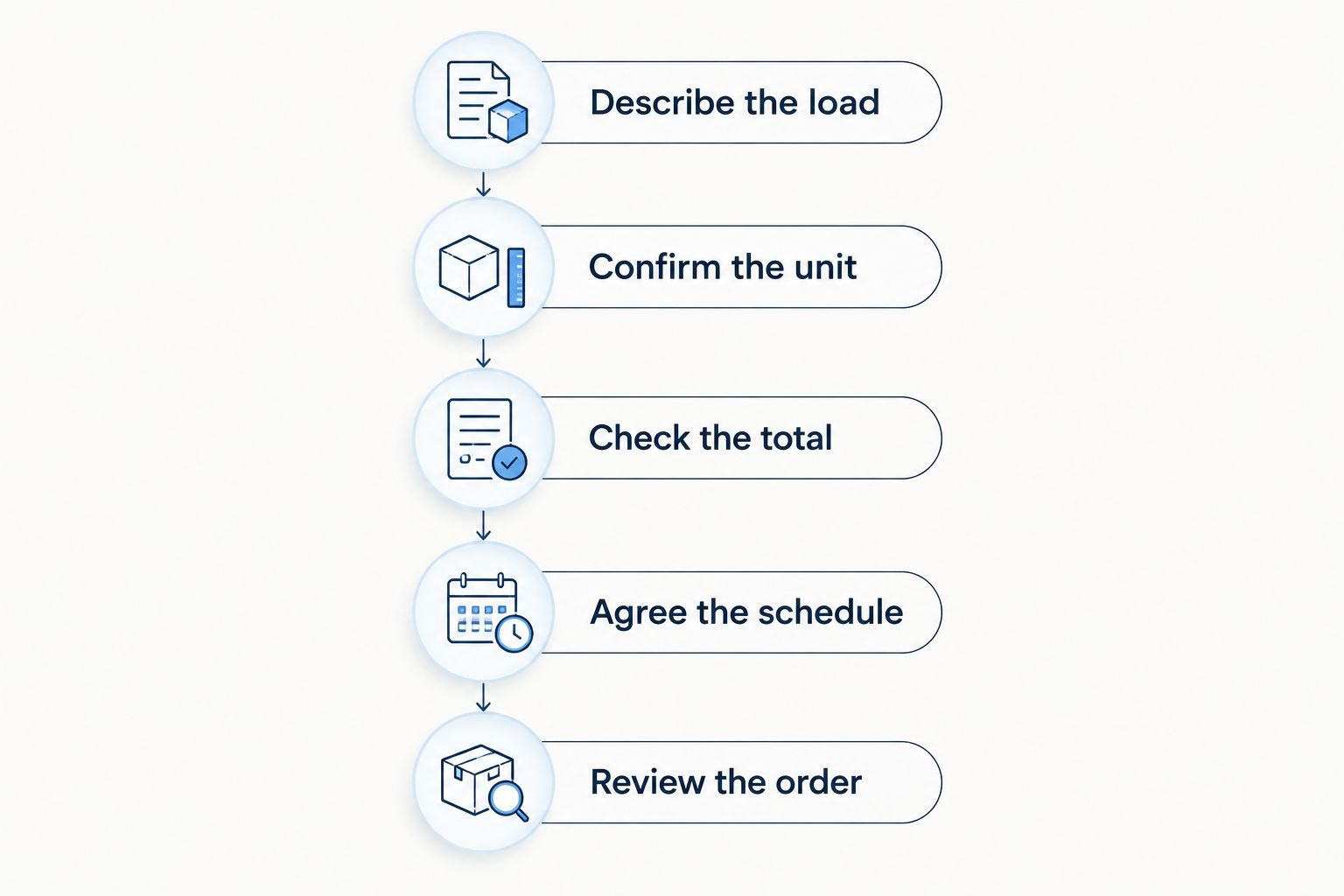
- Describe the load. Identify everyday clothing, towels, bedding, and anything with special care instructions. Ask which items the provider accepts.
- Confirm the unit. Ask whether billing uses pounds, a bag, or another defined basis. Request the rules that apply to that unit.
- Check the total. Ask about minimums, transportation, and separately handled items before approving collection.
- Agree the schedule. Confirm pickup arrangements and the expected return before you depend on the service.
- Review the order. Keep the quote and instructions together so you can compare the completed service with what you requested.
Make your 2026 household decision around the chore you want removed. If the problem is evenings spent washing and folding, ask about the whole pickup-to-return process—not just the washing calculation.
For repeat use, confirm how future collections are arranged. Do not assume the first booking automatically creates a recurring schedule or that later orders follow unchanged terms.
How to request a recurring commercial towel quote
Business laundry needs its own request. A household quote does not establish the terms for repeated towel collections from a gym, salon, spa, or short-term rental operation.
Describe your towel use and collection needs. Explain when clean stock must be ready, where used towels wait, and who handles the handoff. Ask the provider which details it needs to define the service.
For a gym, connect the conversation to class activity and towel use. For a salon or spa, explain the treatments and products associated with the towels. For an Airbnb host, describe turnover timing and the items you want handled.
Ask for the recurring service scope in writing. It should make clear what you are sending, how collection works, and which return arrangements you have agreed. Do not treat an informal discussion as a confirmed operating schedule.
The benefit of a recurring arrangement is having laundry collection built into your routine. The trade-off is coordination: your staff still need clear instructions for storing used towels and receiving the return.
If scheduling is the main issue, the guide to connecting gym towel restocking to your class schedule addresses that planning question separately from the billing unit.
Where local pickup fits your decision
Summa Laundry is best for households needing wash-and-fold pickup and local businesses seeking recurring towel service. Those are distinct needs, so start by saying which service you want.
Home and business pickup is available in Buckhead. If you are comparing service in Suwanee, Snellville, Grayson, or Loganville, give your exact address when you inquire rather than treating a nearby city name as confirmation of your collection arrangements.
The practical benefit is having a pickup service to discuss instead of planning around doing the washing yourself. The boundary is equally important: do not book wash-and-fold as a substitute for dry cleaning or assume self-service machines are part of the offering.
For your 2026 inquiry, ask Summa Laundry to confirm the current billing basis, accepted items, pickup arrangements, and expected return. Households should request a wash-and-fold pickup; businesses should ask about recurring towel service.
Request the service you need
Ask about household wash-and-fold pickup or recurring commercial towel service.
Is a lower per-pound rate always a better deal?
No. A lower per-pound rate is only comparable when the service scope matches. Check the same load, minimum-charge rules, transportation arrangements, and handling requirements before choosing.
Do not assign a savings figure to missing information. Ask the provider to explain the complete order instead of filling the gaps yourself.
Can I compare household laundry with commercial towel service?
Compare household laundry and commercial towel service separately. Household wash-and-fold addresses personal laundry, while recurring towel service needs a discussion about business use and collection routines.
A household quote can explain a billing method. It does not confirm commercial terms, a repeat schedule, or acceptance of your business’s towels.
What should I ask before the first pickup?
Ask what is accepted, how the order is billed, and when it is expected back. Then confirm where to leave the laundry and how to communicate care instructions.
Keep the answers with your booking. Clear instructions before collection are more useful than trying to resolve an assumption after the laundry has left.
FAQ
How much does wash and fold cost per pound in 2026?
Wash-and-fold cost per pound depends on the provider’s current rate and billable weight. Ask for the complete order calculation, including any minimum or separately quoted services, before booking.
How do I calculate a per-pound wash-and-fold order?
Multiply the provider’s quoted per-pound rate by the billable laundry weight to calculate the base charge. Then apply the provider’s confirmed minimum-charge rules and any agreed separate charges.
Is per-pound billing better than bag-based billing?
Neither billing method is automatically better. Per-pound billing requires a clear weight calculation, while bag-based billing requires a defined bag and filling rules; compare the complete service terms.
Does a wash-and-fold quote include pickup and delivery?
Ask the provider to confirm whether pickup and delivery are included in the quote. Do not assume transportation terms from the advertised washing rate.
Can I send towels with my household wash-and-fold order?
Confirm towel acceptance and billing with the provider before collection. If the towels come from a business, describe their use and ask whether commercial towel service is the appropriate arrangement.
Does Summa Laundry offer recurring towel service?
Summa Laundry offers recurring commercial towel service for local businesses, including gyms, salons, spas, and Airbnb hosts. Ask about the service scope and collection arrangements for your operation.
Can homes and businesses request pickup in Buckhead?
Home and business pickup is available in Buckhead. Confirm your exact address, requested service, and collection arrangements when you inquire.
One last thing
Before choosing a provider in 2026, ask for the quote to be explained back to you using your actual laundry request. You should understand the billing unit, the included work, and the pickup-to-return arrangement without guessing.
Book a defined service, not an isolated rate. For a household, that means laundry handled around your routine. For a business, it means towel collection discussed around the work your team needs to do.