
Instead of manually chasing classroom laundry every day, build a daycare linen pickup schedule that connects each required linen change to a collection, a confirmed return, and enough clean stock to cover the gap. Start with your center’s care requirements—not the pickup day—and assign a named person to every handoff.
- Build your daycare linen pickup schedule around required changes, confirmed returns, and clean reserves.
- Summa Laundry provides household wash-and-fold pickup and recurring commercial towel service; confirm daycare linen acceptance before booking.
- Keep routine collections separate from urgent linen changes so staff never wait for pickup to replace soiled items.
- Assign collection preparation, driver handoff, and clean-linen receiving to named staff members.
Why this matters
A weekly collection does not determine when bedding needs changing. Your center’s policies, applicable childcare requirements, and the condition of each item determine that. Pickup is the transport arrangement that supports those responsibilities.
Summa Laundry fits households seeking wash-and-fold pickup and local businesses seeking recurring towel service. For daycare sheets, blankets, or other center-owned textiles, confirm item acceptance and handling requirements before making the service part of your operating plan. Start with Summa Laundry to discuss the actual items and pickup address.
For your 2026 routine, make the whole cycle visible: remove used linen, prepare the collection, hand it over, receive clean items, and restock classrooms. A reminder that only says “laundry day” leaves too much work unassigned.
Before you start
- Gather your operating requirements. Have your center’s linen-change policy, relevant childcare requirements, textile care labels, classroom assignments, and operating calendar ready. Separate center-owned linen from items families take home.
- Confirm service fit and access. Ask Summa Laundry whether the specific daycare items are accepted, what preparation is required, how collection and return work, and whether the pickup address is served. Identify who can authorize service and receive deliveries.
- Resolve the hidden gap: return timing. Pickup does not mean immediate replacement. Count the clean stock needed while items are away, and agree on a fallback before the first collection. Do not assume that commercial towel service automatically includes daycare bedding.
Use a shared calendar and a simple register, or a paper sheet at the staff handoff point. The field names below are labels for your own template—not claims about a provider’s booking interface.
Classroom linen register
The register connects actual classroom needs to the collection plan. Build it before choosing a recurring pickup slot.
- List the items. Create columns labeled Room, Item, Owner, Care instructions, and Change rule. Record sheets, blankets, towels, and other textiles separately rather than grouping everything as laundry.
- Record the trigger. In Change rule, enter the requirement from your center’s policy and applicable rules. Distinguish scheduled changes from changes needed because an item becomes soiled.
- Count usable stock. Add In use, Clean reserve, and Awaiting washing. Exclude damaged or otherwise unusable items from the available total.
- Assign responsibility. Add Room lead and Backup. Name the people who remove used items and request replacements.
- Separate ownership. Mark parent-owned belongings clearly. Follow your center’s established process rather than automatically sending them with center-owned laundry.
Expected result: Every listed item has an owner, a change rule, a stock count, and a responsible staff member. You can identify what belongs in the collection without asking each classroom again.
Check the reserve before setting collection day
For a sample inventory exercise, imagine 12 sheets in use, 12 sheets awaiting washing, and 12 clean sheets on the shelf. That is 36 sheets total, but only the shelf stock is immediately available for the next change. This is an illustration, not a required stock level or hygiene standard.
Your actual reserve must cover planned changes and unplanned replacements until clean items return. If it cannot, change the inventory or collection arrangement before starting. Do not stretch the change policy to fit the laundry schedule.
Pickup and return calendar
A useful calendar shows when items leave and when clean replacements become available. It also names the person responsible for each event.
- Work backward from the next change. Identify when each classroom needs clean items. Use the register’s actual change rules, not an assumed once-a-week replacement cycle.
- Confirm the service window. Agree on collection and return arrangements before adding recurring events. Record the agreed details in Collection window and Expected return.
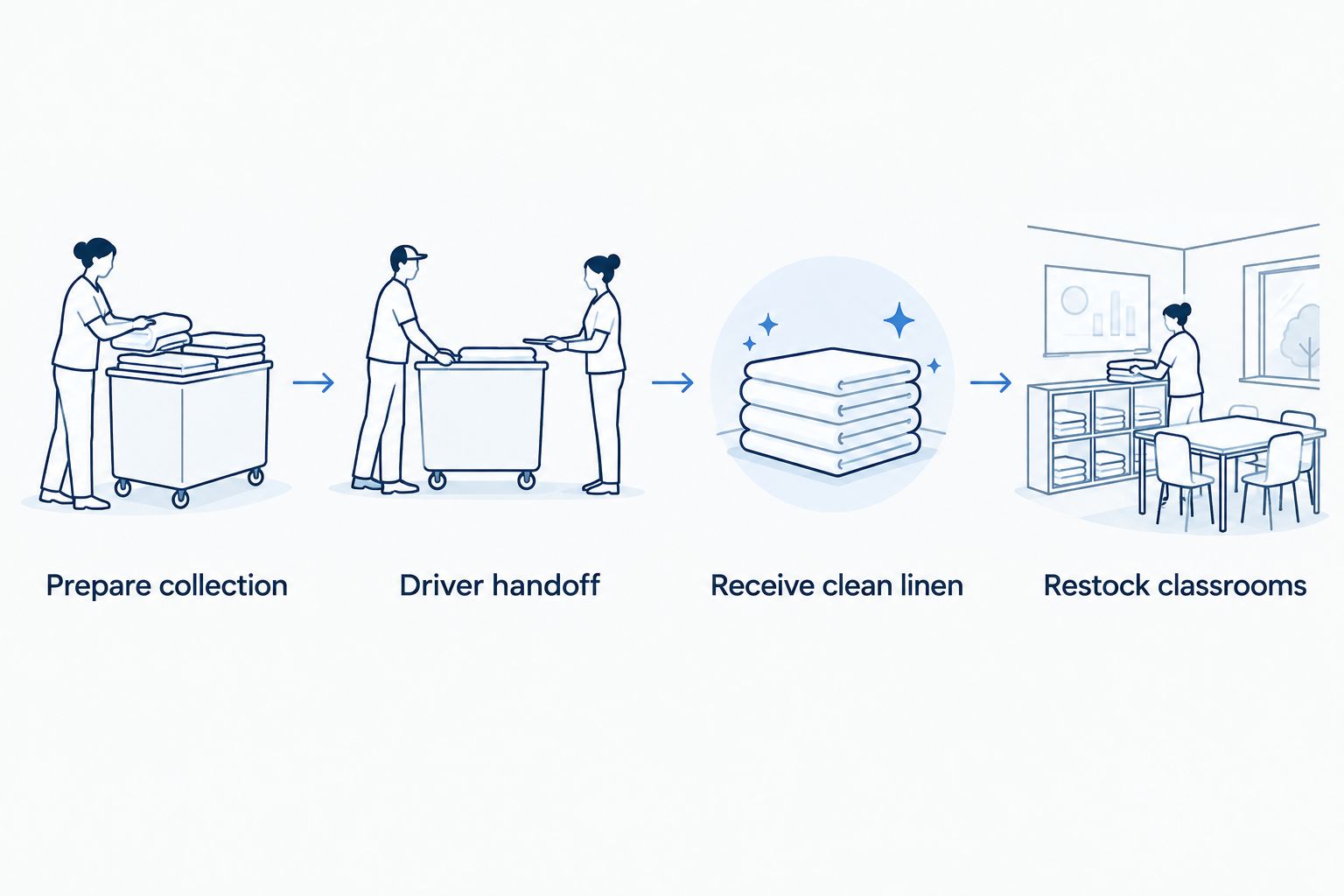
- Create separate calendar events. Use Prepare collection, Driver handoff, and Receive clean linen. Put the task owner and backup in each event’s description.
- Add an internal cutoff. Choose when rooms must finish preparing eligible items for collection. Leave staff enough time to count and check them before the agreed handoff.
- Review closures. Check the 2026 calendar for center closures and provider schedule changes. Confirm affected collections directly rather than letting a recurring reminder stand in for an agreement.
Expected result: Staff can see the collection preparation deadline, handoff responsibility, expected return, and next classroom restock without searching messages.
The calendar should follow this sequence. A completed driver handoff does not close the task; receiving and restocking do.
Choose a routine that matches the work
These are operating approaches, not different service packages. Confirm any additional collection arrangement with the provider before relying on it.
| Approach | Best for | Main advantage | Main limitation |
|---|---|---|---|
| Fixed weekly collection | Centers whose accepted laundry and reserve fit a weekly cycle | Gives staff a repeating preparation and handoff routine | Does not cover every unexpected replacement need |
| Weekly collection plus an exception process | Centers that need a defined response to additional soiling or changing attendance | Keeps urgent replacements separate from routine transport | Requires backup stock and an assigned decision-maker |
Use a fixed collection as the baseline only when the clean reserve supports it. Add an exception process regardless; an urgent linen change cannot wait for the next scheduled collection.
Collection and receiving checklist
A bag leaving the building is not proof that the right items left. A returned load is not proof that every room has been restocked.
- Prepare accepted items. Follow the provider’s instructions and your center’s handling procedures. Keep clean stock separate from used items. Do not send items requiring special handling without confirming acceptance and preparation.
- Identify the collection. Record Room, Item, Count, and Collection date in your register. Use the agreed labeling method; avoid adding unnecessary child information.
- Confirm the handoff. Have the assigned staff member record Collected by and Handoff completed. If access changes, notify the provider rather than assuming the driver can use another entrance.
- Check the return. Compare returned items with the collection record. Record missing or damaged items and raise discrepancies promptly.
- Restock classrooms. Put clean items into the designated clean storage area under your center’s procedures. Update Clean reserve and mark Restock completed.
Expected result: The register shows what left, what returned, and which classrooms received clean replacements. An absent staff member does not erase the handoff history.
For questions about service scope rather than calendar setup, use the commercial laundry guide for daycare centers. Keep your center’s required procedures separate from any provider’s general service description.
Exception and attendance rules
The second workflow handles changes after the weekly plan is set. It starts with a classroom need—not an automatic extra booking.
- Log the change. Add Exception reason, Items needed, and Needed by when attendance, soiling, or another operational change affects the plan.
- Replace from clean stock. Follow the center’s change requirements immediately. An exception record must never become permission to leave an unsuitable item in use.
- Recalculate coverage. Check whether the remaining clean reserve covers needs until the confirmed return. Count usable items, not bags.
- Escalate the gap. Assign Decision owner to approve the fallback. Confirm any altered service arrangement directly; do not treat a calendar edit as a provider confirmation.
- Update the next cycle. If the same shortage repeats, revise the baseline inventory or collection plan instead of handling it as a fresh surprise.
Expected result: Staff know when to use reserve stock, who resolves a shortage, and what requires direct provider confirmation.
For your 2026 exception log, keep the reason specific: an extra classroom opened, reserve stock was damaged, or a return was delayed. A useful record explains what changed and what action followed. It does not need a long narrative.
Households can use the same ownership rule on a smaller scale: separate daycare take-home items from the household wash-and-fold load, check care instructions, and confirm acceptance before sending them.
Troubleshooting
Clean linen runs out before the return
Recount the clean reserve against the actual next change needs. Check whether stock was counted while still awaiting washing or whether attendance changed. Restore coverage through the agreed fallback, then adjust inventory or the collection arrangement.
The driver arrives before classrooms are ready
Move the internal preparation cutoff earlier and assign a backup. Keep the agreed collection window unchanged unless the provider confirms a different arrangement. A staff reminder cannot change the driver’s schedule.
Items return without a clear classroom destination
Compare the return with the room-level collection register. Confirm an identification method with the provider before the next collection, and assign receiving to someone who can resolve mismatches before restocking.
An item needs handling outside the routine
Keep it out of the standard collection until the appropriate handling process is established. Follow your center’s procedures and applicable guidance, then ask the provider about acceptance. Do not assume ordinary wash-and-fold covers every contamination situation.
A closure disrupts the recurring event
Confirm the replacement arrangement directly and update both the preparation and receiving events. Recheck reserve coverage across the closure. For the 2026 calendar, include a named owner for holiday confirmations rather than relying only on automated reminders.
Customize your workflow
Start with the tasks that cause repeated interruptions: collecting classroom counts, finding the handoff person, or locating clean replacements. Fix that handoff before adding more reminders.
For a center with multiple rooms, use a separate register row for each room and textile type. For a household, use a simpler list of daycare belongings and home laundry. Keep ownership clear even when collection happens on the same day.
When discussing Summa Laundry’s pickup-and-delivery service, give the exact address and item list. The owner confirms home and business pickup in Buckhead; for Suwanee, Snellville, Grayson, and Loganville, confirm the address-specific arrangement. Do not treat service-area coverage as confirmation that every daycare textile is accepted.
Confirm your laundry pickup needs
Discuss your address, accepted items, and collection needs before building the recurring schedule.
FAQ
What is the best daycare linen pickup schedule?
The best daycare linen pickup schedule follows required linen changes and leaves enough clean stock until the confirmed return. A weekly collection works only when your inventory and service arrangement support that cycle.
Does a weekly pickup mean daycare sheets only need changing weekly?
No. Collection frequency does not determine linen-change frequency. Follow your center’s policies, applicable childcare requirements, and the condition of each item.
Does Summa Laundry accept daycare sheets and blankets?
Confirm daycare sheets and blankets directly before booking. Summa Laundry provides wash-and-fold pickup and recurring commercial towel service, but those categories do not establish acceptance of every daycare item.
How many spare sheets should a daycare keep?
Keep enough usable clean sheets to cover required changes and unexpected replacements until the confirmed return. Calculate the reserve from your center’s actual needs rather than using a universal spare-sheet count.
What should staff do when linen becomes soiled before pickup day?
Replace the item according to the center’s procedures without waiting for pickup. Record the exception, check the remaining clean reserve, and follow the agreed handling process.
Can parents include daycare belongings in household laundry pickup?
Confirm that the provider accepts each item and check its care instructions before including it. Keep personal belongings identified and follow the daycare’s take-home laundry requirements.
What should go in a recurring pickup request?
Provide the exact address, textile types, collection needs, access instructions, and receiving contact. Confirm acceptance and return arrangements before treating the request as a working schedule.
One last thing
Track the next clean-linen need, not just the next pickup. A collection can happen exactly as planned while a classroom still lacks replacements. Put Next clean stock needed in your 2026 register and review it when items leave the building.