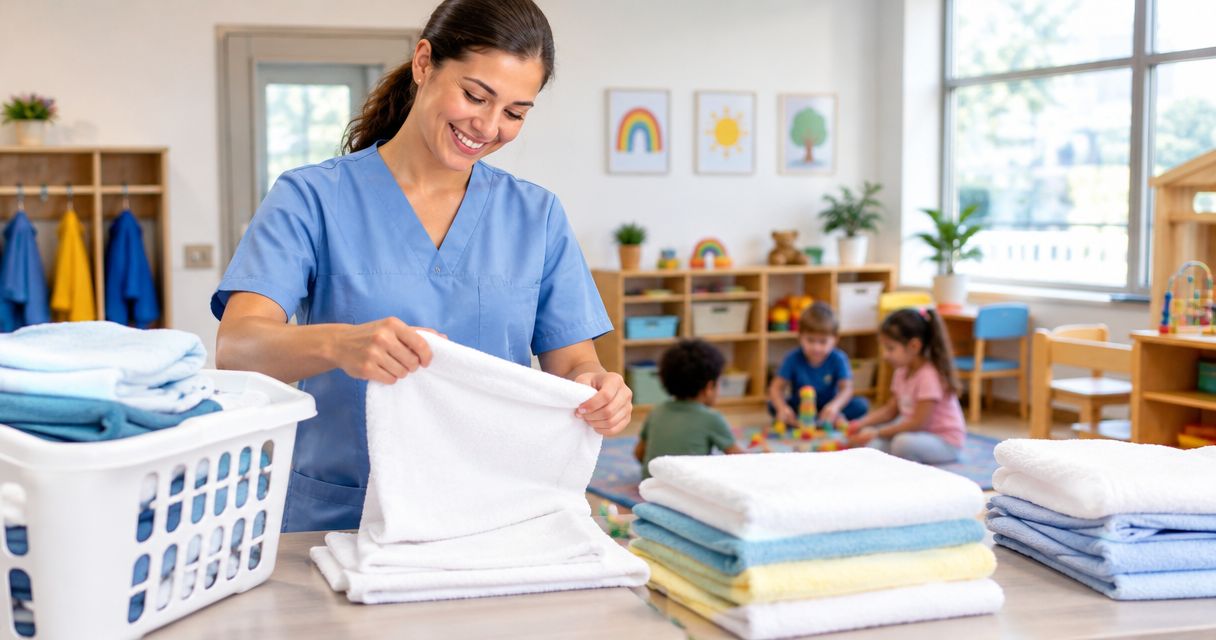
Daycare commercial laundry service is outsourced washing, drying, and folding of accepted childcare textiles with the aim of keeping clean supplies ready without assigning every load to staff. This 2026 guide explains how to assess commercial laundry service for daycare centers, separate routine linens from special-handling items, and choose a pickup arrangement that fits your center’s procedures.
- Commercial laundry service for daycare centers starts with an accepted-item list, not a pickup booking.
- Summa Laundry is best for local businesses seeking recurring towel service; daycare textile acceptance needs confirmation.
- Keep routine wash-and-fold, contaminated items, and family-owned clothing on separate handling plans.
- Choose pickup frequency from actual textile use, confirmed return timing, and clean reserve stock.
Why commercial laundry matters for daycare centers
Daycare laundry involves more than getting a basket empty. You need the right sheets, towels, and washable classroom items back where staff can find them. A missed handoff creates work even when the washing itself happens elsewhere.
Buy a workable laundry routine, not just a wash. Your decision should account for sorting, storage, collection, return checks, and the items a provider will not accept. Outsourcing routine loads does not replace your center’s infection-control procedures.
Summa Laundry provides wash-and-fold pickup and delivery and recurring commercial towel service. Summa Laundry is best for local businesses seeking recurring towel service. For daycare use, confirm the accepted textiles and handling requirements before treating the service as a fit.
That distinction matters in 2026: a general laundry offering is not evidence of specialized childcare processing. Keep household booking and business inquiries separate, too. A parent’s personal wash-and-fold order does not establish a center-wide laundry arrangement.
Build a daycare laundry plan before booking
1. List every textile you need washed
Start with a paper inventory or a simple spreadsheet. Walk through the classrooms, changing areas, kitchen, and storage spaces. Record what actually enters the laundry rather than estimating from enrollment alone.
Separate center-owned linens from children’s personal belongings. Then distinguish routine washable items from anything your written procedures assign to special handling. A provider needs that distinction before accepting the work.
Make the list specific enough to answer questions without another walkthrough. A category called classroom laundry hides too much; fitted cot sheets, reusable cleaning cloths, and washable dress-up clothing raise different acceptance questions.
Record ownership and destination alongside the item type. That small addition helps prevent clean returns from becoming another sorting task.
- List each textile type and its classroom or storage location.
- Mark whether the center or a family owns it.
- Record care-label restrictions and drying instructions.
- Separate routine loads from special-handling categories.
- Identify items that must return to a named child or room.
2. Measure use before choosing pickup frequency
Use a manual tally before asking for a recurring schedule. Track clean items issued, items sent to laundry, and usable stock remaining. Repeat the exercise across a normal operating week rather than choosing a schedule from the size of the laundry basket.
For a practical 2026 baseline, log use for 5 operating days. That is a suggested measurement period, not an industry benchmark. Add another observation period if closures or unusual attendance make the first week unrepresentative.
Your clean reserve should cover use while laundry is away, plus a buffer you choose for unexpected changes. Work from the provider’s confirmed collection and return arrangement. Do not build the plan around an assumed next-day return.
For towel-heavy routines, Summa Laundry’s recurring commercial towel service is an option to discuss after you know your volume. Confirm daycare towel acceptance and collection details rather than assuming the general service covers every item.
- Count daily use by textile type and room.
- Record the busiest observed day separately.
- Count usable clean stock, excluding damaged items.
- Calculate needs across the confirmed collection-to-return interval.
- Set a reserve and a trigger for requesting help.
3. Confirm acceptance and handling requirements
Begin with your center’s written procedures and applicable childcare requirements. Turn them into a short provider questionnaire. Ask for clear answers before sending a trial load, especially where staff use the word sanitizing without defining the required process.
Routine wash-and-fold is not proof of a disinfection process. Cleaning and disinfection are different activities. Ask what the provider actually does, and compare that answer with the requirements governing your center.
Describe bodily-fluid contamination and other special-handling situations explicitly. Do not assume an ordinary pickup service accepts those items. Keep them on your established handling route unless acceptance and an appropriate process are confirmed.
You also need clarity about family-owned garments. A center-wide service should not quietly change what families are responsible for taking home.
- Send the provider your proposed accepted-item list.
- Ask which items and conditions are excluded.
- Confirm washing and drying compatibility with care labels.
- Ask how clean and soiled textiles remain separated.
- Document the route for rejected or special-handling items.
4. Set up a clear pickup and return handoff
Create a manual handoff sheet before adding software or extra notifications. Record who prepared the collection, what left the building, and where returns belong. Keep the process simple enough for a substitute staff member to follow.
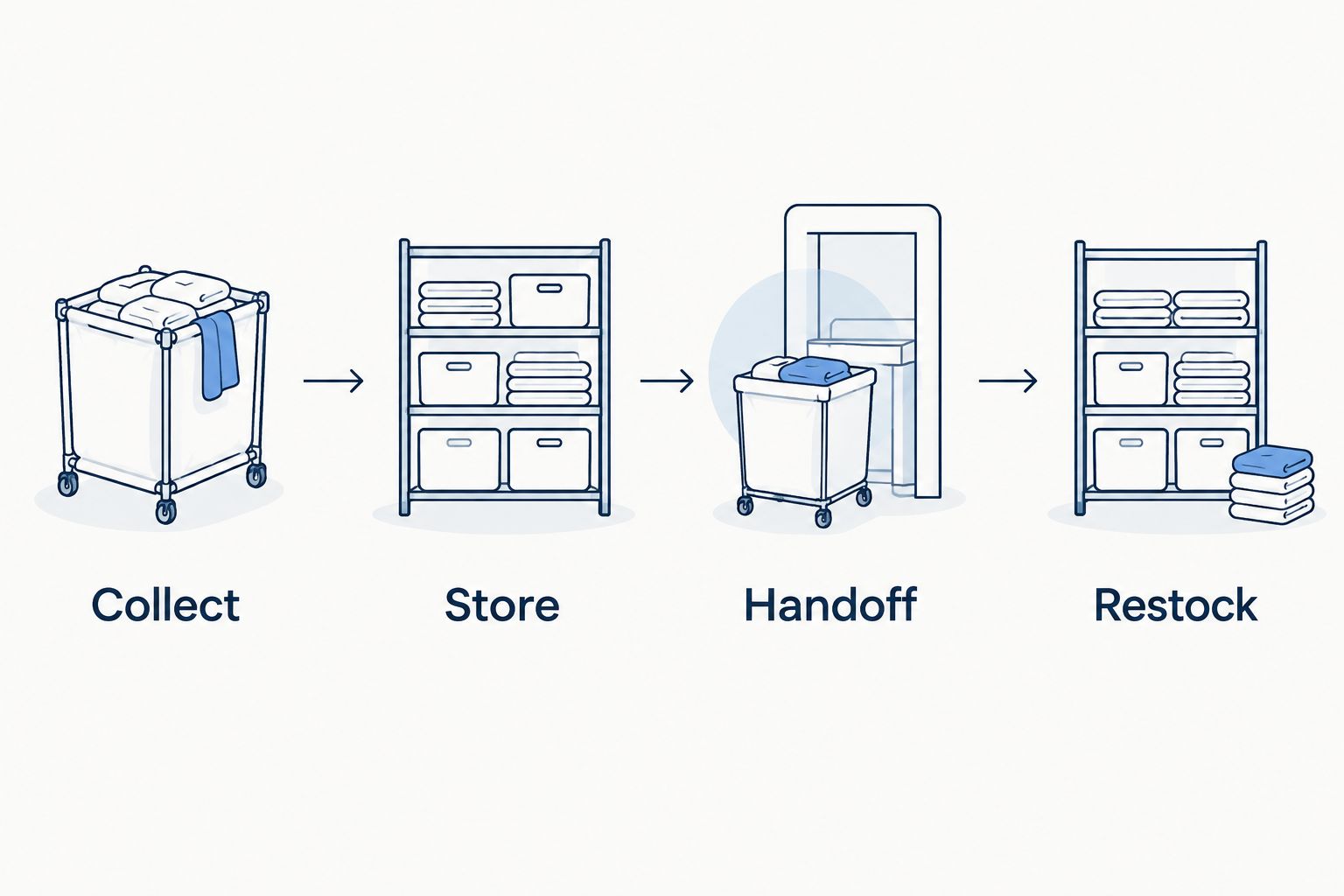
Use four stages: Collect, Store, Handoff, Restock. Each stage needs a designated place and a responsible staff role. Keep collection activity away from children and avoid placing clean returns in the soiled-laundry area.
For centers planning service in Suwanee, Snellville, Grayson, Loganville, or Buckhead, provide the exact address and access instructions. Confirm the arrangement for that location rather than relying on a nearby city name.
- Collect accepted textiles using your center’s handling procedures.
- Store soiled items separately from clean supplies.
- Handoff collections at an agreed staff-controlled location.
- Restock returns by room, owner, or textile type.
- Record exceptions before closing the handoff sheet.
A clear handoff also protects the benefit you wanted from outsourcing. If staff spend the morning searching for returned sheets, the process still needs work even when the textiles arrive clean.
5. Test the arrangement before expanding it
Start with an agreed routine category rather than moving every textile at once. Keep your existing fallback available while you check the first collection and return. Expansion should follow evidence from your own operation.
Use 3 return checks: completeness, condition, and correct sorting. Compare the returned items with the dispatch record, inspect for remaining soil or dampness, and confirm that staff can identify where each item belongs.
Do not judge the service only by folding. A neatly packed return that arrives outside the agreed handoff arrangement still disrupts the center. Record problems in plain language and agree on how they will be resolved.
For your 2026 trial, define success before collection: accepted items returned as agreed, clear exceptions, and a workable restocking routine. Keep the criteria tied to what your center needs.
- Send only items the provider has agreed to accept.
- Record the collection contents using a consistent method.
- Check completeness, condition, and correct sorting on return.
- Measure staff time spent preparing and restocking the load.
- Resolve exceptions before increasing the collection scope.
6. Review the full workload, not just washing
Use a short staff log to compare the old routine with the trial. Include sorting, machine loading, drying, folding, transport, handoffs, and restocking wherever those tasks apply. The useful result is less disruption, not simply fewer loads inside the building.
Review after 1 operating week of the trial, then extend the review if that period does not reflect normal use. This is a suggested checkpoint. It is not a promised service timeline.
Assign responsibility for updating the plan when classroom use changes. An arrangement that works for towels does not automatically work for bedding, personal clothing, or washable classroom materials.
Keep one written 2026 service plan that staff can actually use. Include the accepted-item list, responsibilities, escalation contact, and fallback procedure. Replace outdated copies when the arrangement changes.
- Compare total staff handling time before and during the trial.
- Record shortages, rejected items, and return problems.
- Check whether reserve stock covered the laundry interval.
- Update room labels and staff instructions where needed.
- Expand only the textile categories that passed the trial.
Discuss your center’s laundry needs
Ask Summa Laundry about accepted textiles, recurring towel service, and pickup at your center.
Compare daycare laundry options
Choose the operating model before choosing a provider. The right option depends on your accepted textiles, staff capacity, equipment, and required handling process—not on a general claim that outsourcing is always better.
| Option | Best for | Main advantage | Key limitation |
|---|---|---|---|
| On-site staff washing | Centers with suitable equipment and an established laundry procedure | Direct control over load order and access to equipment | Staff retain washing, folding, maintenance coordination, and restocking tasks |
| Staff-managed drop-off wash-and-fold | Centers able to manage transport and provider handoffs | Moves accepted washing and folding outside the center | Staff still handle transport; acceptance and processing need confirmation |
| Pickup-and-delivery wash-and-fold | Centers seeking to remove transport from routine laundry work | Combines collection with washing and folding of accepted items | Requires sufficient reserve stock and confirmed textile acceptance |
| Summa Laundry recurring commercial towel service | Local businesses seeking recurring towel collections | Offers a service category specifically focused on recurring towel needs | Daycare acceptance, non-towel items, and handling requirements need confirmation |
| Specialist textile provider | Centers whose documented requirements call for a specialized process | Allows selection against specific handling requirements | Specialization must be verified; a commercial label alone proves nothing |
Keep any option that meets your documented requirements; reject any option that cannot explain its limits. A provider declining unsuitable items gives you useful information. Do not pressure a routine laundry service into a process it has not agreed to perform.
Common mistakes daycare centers make
Mixing personal clothing into the center’s service
A child’s spare outfit and a center-owned towel have different ownership and identification needs. Set a written boundary and communicate it to families. Do not let an unlabeled garment enter a shared collection by default.
Treating every dirty textile as an ordinary load
Visible dirt, care-label restrictions, and contamination require different decisions. Follow your center’s procedures and the provider’s acceptance rules. Keep a clear route for anything excluded from the routine service.
Planning from enrollment instead of actual use
Enrollment does not tell you how many towels or sheets enter the laundry each day. Measure use by textile type. Keep personal emergency clothing separate from the center’s clean linen reserve.
Forgetting the clean-return storage area
Outsourcing washing does not create shelf space. Decide where clean returns go before the first collection. Staff should not need to clear a changing surface or sort bags in an occupied classroom to put laundry away.
Assuming laundry service changes sanitation duties
Clean textiles do not replace handwashing, surface cleaning, or other childcare procedures. Keep those responsibilities in your operating plan. Describe laundry outsourcing as a task arrangement, not a blanket hygiene guarantee.
FAQ
What is commercial laundry service for daycare centers?
Commercial laundry service for daycare centers is outsourced processing of accepted childcare textiles, such as routine washable linens or towels. The center must confirm which items the provider accepts and whether its process meets the center’s requirements.
Does Summa Laundry accept daycare laundry?
Daycare textile acceptance needs confirmation with Summa Laundry. The business provides wash-and-fold pickup and delivery and recurring commercial towel service, but those offerings do not establish acceptance of every childcare textile.
Can I send soiled daycare clothing with regular laundry?
Do not send special-handling clothing with routine laundry unless your center’s procedures and the provider’s acceptance rules permit it. Keep family-owned items and bodily-fluid contamination on clearly documented handling routes.
How often should a daycare schedule laundry pickup?
Schedule pickup from measured textile use, confirmed return timing, and available clean reserve stock. Log a normal operating week before choosing a recurring arrangement.
Is pickup laundry better than washing at the daycare?
Pickup laundry is a better operational fit when accepted textiles can leave the building without creating shortages and the arrangement reduces staff work. On-site washing retains direct control but keeps equipment and processing responsibilities with the center.
Does wash-and-fold disinfect daycare sheets?
A wash-and-fold label does not establish that a disinfection process is included. Ask for the actual process and compare it with your center’s written procedures and applicable requirements.
What should I ask before arranging daycare laundry pickup?
Ask about accepted items, exclusions, collection access, return arrangements, identification, and exception handling. Provide the exact center address and describe special-handling needs before booking.
One last thing
Label the destination before the laundry leaves. A clean sheet still creates work if nobody knows which room or child it belongs to. Make identification part of the trial, not a correction after the first mixed return.
Keep the final decision narrow. Approve the textile category and handling arrangement you have checked—not every future laundry need your center might have.