
Laundry pickup and delivery is cheaper than doing it yourself only when the service total is lower than the laundry expenses and paid labor it replaces. For households, time saved adds convenience but does not automatically reduce spending; for businesses, staff time counts as a cash saving only when outsourcing actually reduces payroll or overtime.
- Is laundry pickup and delivery cheaper than doing it yourself? Compare total expenses, not detergent alone.
- Household time saved is valuable, but it is not automatically money saved.
- Businesses should distinguish reduced laundry work from actual reductions in paid labor.
- Summa Laundry serves households needing wash-and-fold pickup and businesses seeking recurring towel service.
Why this matters
Stop comparing a laundry service bill with a bottle of detergent. Compare the same amount of laundry, the same finished result, and the expenses that actually change.
For your 2026 decision, keep money and convenience separate. You can reasonably choose pickup because you want your evenings back without claiming that it lowers your bills. The guide to whether laundry pickup and delivery is worth it covers that broader decision.
Is laundry pickup and delivery cheaper than doing it yourself?
Pickup is the cheaper option when its total charge is below your avoidable DIY costs. Those costs differ between a household washing clothes at home and a business paying employees to process towels.
Use this comparison to identify what belongs in your calculation. These are decision criteria, not a ranking of local providers.
| Option | Best for | What belongs in the comparison | Main advantage | Main limitation |
|---|---|---|---|---|
| Home washing | Households prioritizing direct control | Detergent, utilities, and other expenses that change with use | You control the timing and handling | You still sort, transfer, fold, and put away |
| Self-service laundry | People who need access to washing equipment | Machine charges, supplies, travel, and your time | You handle the work without owning the machines | Travel and hands-on work remain |
| Household pickup and delivery | Families and professionals wanting less laundry work | Complete service charge and remaining preparation | Washing and folding move off your task list | You work around the agreed collection and return schedule |
| Recurring commercial towel service | Businesses seeking an alternative to in-house towel processing | Service charge, remaining staff work, and expenses removed | Towel processing becomes an outside service | You still need storage, stock planning, and a workable handoff |
Do not count every expense associated with your washer as an immediate saving. If the appliance stays in your home, its original purchase cost does not disappear when you book pickup.
Likewise, do not treat every minute an employee spends on towels as money you will recover. Reassigned time and reduced payroll are different outcomes.
Household laundry: separate spending from time saved
For a household, start with the expenses that stop when you stop washing those clothes yourself. Include the relevant detergent, laundry additives, water, and energy. Include travel when your current routine requires a separate laundry trip.
Then list what stays. You still put clothes away, and you might still wash items that are unsuitable for your chosen service. Compare the work that disappears, not an imaginary laundry-free household.
Your personal time belongs in a separate column. You do not earn extra money simply because folding disappears from Sunday evening. The benefit is that you can use that evening differently.
This distinction gives you an honest answer:
- If pickup reduces your cash spending, it is cheaper.
- If pickup increases spending but removes work you dislike, it buys convenience.
- If pickup lets you accept paid work you otherwise could not do, compare the actual additional earnings with the additional expense.
For busy families, that last condition needs a real opportunity behind it. Do not assign yourself an hourly wage and count all reclaimed time as income.
Business towel service: separate staff capacity from payroll savings
A gym, salon, or spa has a different calculation. Laundry can involve paid collection, sorting, washing, drying, folding, and restocking. Outsourcing changes some of those tasks, not necessarily all of them.
Record the work by role. A receptionist handling towels between appointments presents a different staffing decision from an employee staying late specifically to finish laundry.
Commercial towel service saves payroll only when paid hours or overtime actually fall. If the same employees work the same hours, the benefit is available capacity rather than a smaller wage bill.
That capacity still deserves attention. Your team can use it for assigned customer-facing or operational tasks. Name those tasks before treating the change as a business improvement.
For Airbnb hosts and property managers, compare the laundry handoff with the actual turnover workflow. Ask whether the service accepts the items you need processed and whether the return arrangement fits your cleaning schedule. Do not assume a towel service includes every kind of linen.
Why the cost comparison varies
The result changes with your starting routine and the work you need completed. Check these factors before choosing a service:
- Laundry volume: Compare the same clothes or towels across both options. A light household week is not a useful baseline for a heavy week.
- Current equipment: Owning usable machines creates a different starting point from paying for each self-service wash.
- Travel: Count a dedicated laundry trip differently from an errand already on your route.
- Hands-on work: Sorting, transferring, folding, and restocking require attention even when machines run unattended.
- Paid labor: Business savings depend on whether outsourcing changes paid hours, overtime, or only task assignments.
- Service scope: Confirm what the quoted service covers and which tasks remain yours.
None of these factors proves that pickup is cheaper by itself. Together, they define the comparison you need to make.
How to compare your own costs in 2026
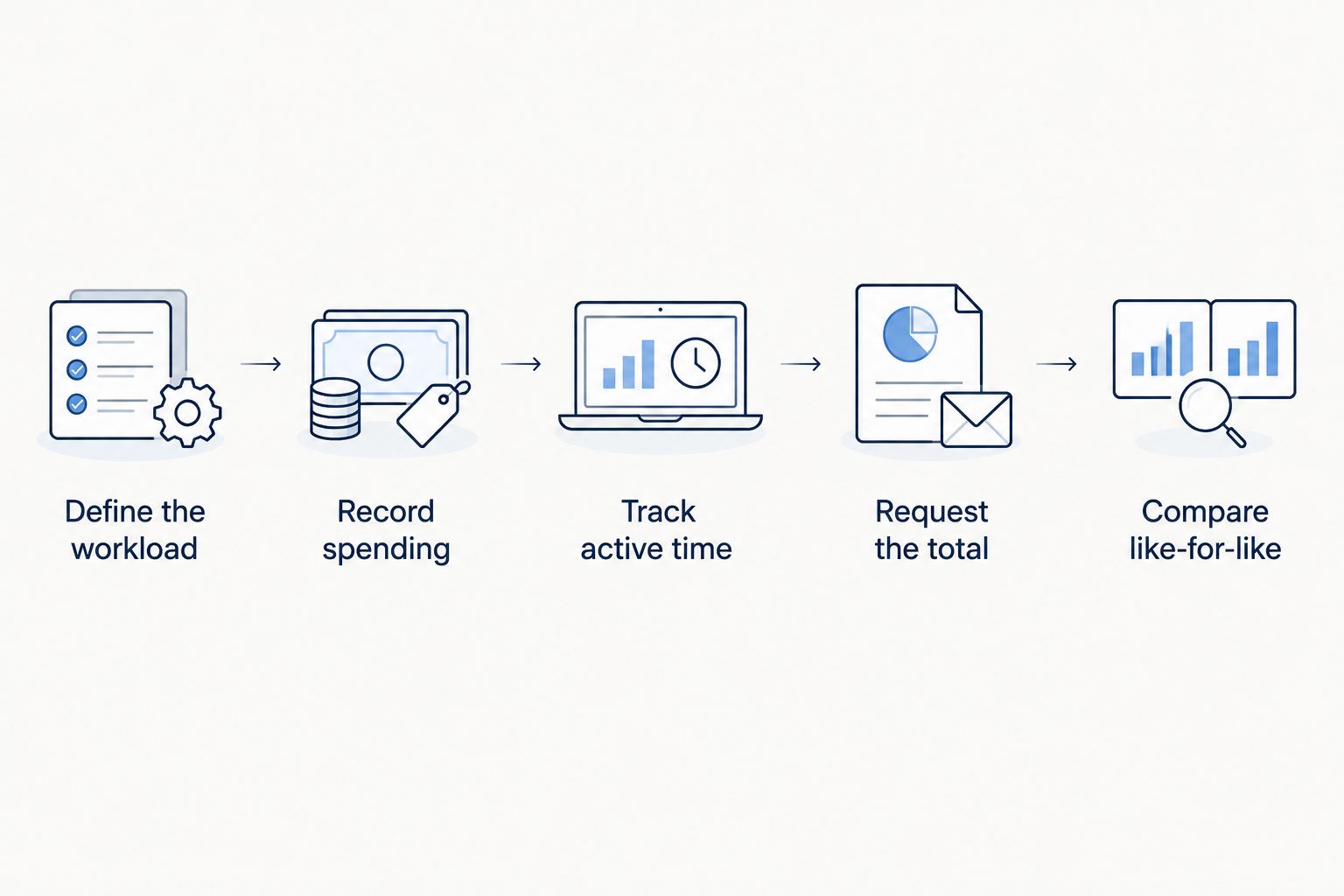
Use a 7-day tracking period as a practical starting exercise. If that period misses your normal workload, extend it rather than treating an unusual week as typical.
1. Define the workload
Write down the clothes or towels you want handled. Separate household wash-and-fold from business towel processing so each decision stands on its own.
Keep special-care items outside the comparison until you confirm that the service accepts them. Pickup and delivery does not mean every fabric or cleaning method is included.
2. Record spending
For DIY laundry, record the supplies, machine use, utilities, and dedicated travel relevant to that workload. Use your own receipts, bills, and appliance information rather than borrowing a national estimate.
For a business, record laundry-related paid time separately. Identify whether those hours would actually leave the schedule after outsourcing.
3. Track active time
Track the minutes you spend sorting, loading, transferring, folding, and making laundry trips. Do not count the entire machine cycle as hands-on labor when you are doing something else.
Also record interruptions. Having to stop another task to move a load is different from continuously working on laundry, but it still affects your routine.
4. Request the total
Describe the same workload when asking about service. Request the complete charge, the accepted items, preparation instructions, and the collection and return arrangement.
For recurring business service, explain when towels become dirty and when clean towels are needed. Ask what happens when your volume changes before agreeing to a routine.
5. Compare like-for-like
Put DIY expenses beside the service total. Then compare time, handling, and scheduling separately.
For your 2026 baseline, label each expense as either avoidable or continuing. This prevents you from claiming savings on equipment, staffing, or travel that you will still pay for.
Make the schedule part of the decision
A favorable cost comparison is not enough if the routine leaves you without needed clothes or towels. Before booking, decide what must remain on hand between collection and return.
For households, check work clothes, school clothing, exercise wear, and anything needed for a fixed event. Keep your essential items out of the first pickup if their care requirements or return timing are unresolved.
For businesses, map towel demand against appointments, classes, or property turnovers. Identify who prepares the collection and who receives and stores the returned items.
When you compare recurring service in 2026, ask for the collection and return arrangement in writing. Treat timing as a requirement to confirm, not an assumption based on the phrase pickup and delivery.
Where Summa Laundry fits
Summa Laundry is best for households seeking wash-and-fold pickup and local businesses seeking recurring towel service. Those are distinct needs: one removes household laundry work, while the other supports a business towel routine.
Home and business pickup includes Buckhead. If you are comparing service in Suwanee, Snellville, Grayson, or Loganville, provide your exact address and describe your workload when contacting Summa Laundry.
The fit is straightforward, but the decision still needs specifics. Confirm the full charge, accepted items, and collection and return arrangements. Do not assume that a household booking and a recurring business inquiry have identical requirements.
For households, the next step is to ask about wash-and-fold pickup. For gyms, salons, spas, and suitable rental operations, ask about recurring towel service and explain how your current routine works.
Choose the right laundry service
Ask about household wash-and-fold pickup or recurring towel service for your business.
Does laundry pickup save money if you already own a washer?
Owning a washer does not settle the comparison. Compare the expenses you avoid by outsourcing, not the original purchase amount of a machine you will keep.
If the service total is higher, pickup is a convenience purchase rather than a direct saving. You can still prefer it without changing the arithmetic.
Is recurring towel service cheaper than paying staff to wash towels?
Recurring towel service is cheaper when its complete charge is below the expenses and paid labor it removes. If payroll stays unchanged, describe the result as reduced laundry work rather than reduced staffing expense.
Check the remaining tasks too. Employees might still collect dirty towels, prepare the handoff, and restock clean towels.
Should you outsource every load?
You do not need to outsource every load. A split routine lets you send suitable wash-and-fold items while handling items that need different care yourself.
The limitation is that some laundry work remains at home or on-site. Recalculate the benefit around the work actually removed.
FAQ
Is laundry pickup and delivery cheaper than doing it yourself in 2026?
Laundry pickup and delivery is cheaper when the complete service charge is below the DIY expenses and paid labor it replaces. Household time saved is a separate benefit unless it creates actual additional earnings.
What should I include when comparing laundry service with washing at home?
Include supplies, relevant utilities, dedicated travel, and any paid labor that changes. Compare the same workload and keep personal time separate from cash expenses.
Should I count the whole washing cycle as time saved?
Count active laundry work separately from unattended machine time. Sorting, loading, transferring, folding, and dedicated trips show the hands-on work you are replacing.
Does outsourcing towels automatically lower a business's payroll?
Outsourcing towels lowers payroll only when paid hours or overtime actually decrease. If employees work the same schedule, the immediate benefit is time available for other assigned tasks.
Is pickup and delivery the same as dry cleaning?
Pickup and delivery describes transportation, not a cleaning method. Confirm the treatment and accepted items before including special-care clothing in a wash-and-fold order.
Can I use pickup for only part of my laundry?
You can compare a partial-service routine instead of assuming every item must be outsourced. Confirm the provider's requirements and include the work you will still handle yourself.
Does Summa Laundry serve households and businesses?
Summa Laundry provides household wash-and-fold pickup and recurring commercial towel service. Describe your address, items, and scheduling needs when asking which service fits.
One last thing
A lower laundry bill and a better laundry routine are different wins. Decide which one you need before comparing providers.
For your 2026 decision, write down the result you want: less spending, fewer evening chores, or less staff time spent processing towels. Then choose against that goal. You do not need to call convenience a financial saving to make it worthwhile.