Yes—property managers can coordinate laundry pickup across multiple units by agreeing on collection locations, unit identification, access and return instructions with the provider. A shared address does not automatically mean a shared order, so confirm how resident laundry, rental linens and business towels will stay assigned before scheduling.
- Property manager laundry pickup multiple units: confirm collection points, unit labels and return instructions before booking.
- Summa Laundry provides household wash-and-fold pickup and recurring commercial towel service; confirm the proposed multi-unit arrangement directly.
- Best for resident clothing: separate orders that preserve each household’s instructions and ownership.
- Best for shared business towels: a manager-controlled handoff with an agreed collection and return location.
Can property managers schedule pickup across multiple units?
Yes. Coordinate the property as a route, but identify the laundry by its owner or destination. That distinction lets you plan a shared handoff without treating every apartment, resident or rental as the same customer.
Start with the provider’s laundry services, then describe your actual setup. Specify whether you manage occupied apartments, furnished rentals or shared amenity towels. Ask the provider to approve the arrangement before telling residents or housekeeping that collection is scheduled.
Use this sequence to prepare your 2026 pickup plan:
- List the units. Record the property address and participating unit identifiers. Separate occupied households from manager-owned rental inventory.
- Identify the laundry. Describe resident clothing, rental textiles and shared towels separately. Confirm which items the provider accepts.
- Choose the handoff. Propose a staffed collection point or individual unit stops. Ask which arrangement the provider can support.
- Confirm the return. Agree on where clean laundry goes, who receives it and how each order remains identifiable.
- Approve the schedule. Get collection and return expectations confirmed before you connect the service to a turnover deadline.
These are planning steps, not a promise that every provider supports every configuration. A multi-unit request needs approval at the address and handoff level.
Why this matters
A pickup schedule is only useful if the right laundry returns to the right place. Moving bags out of the building does not solve the problem when your team still has to work out which household or rental owns them.
Residents need their clothing returned correctly. Property teams need usable inventory where housekeeping expects it. Keep those responsibilities distinct, even when the same manager coordinates the request.
For your 2026 plan, define the handoff before choosing the recurring schedule. An agreed collection point, receiving person and order-identification method give you something specific to manage.
Central collection: best for a staffed property
Central collection means participating units bring laundry to an agreed location, and an authorized person handles the provider handoff. Propose this setup when you control an appropriate storage area and have staff available to receive returns.
The advantage is a single coordination point. The trade-off is responsibility: your property team must keep orders identifiable, control access and distribute returned laundry correctly.
Do not assume a lobby, leasing office or package room is approved for laundry storage. Get property permission and provider agreement first. Confirm whether residents must collect their own returned orders or whether staff will distribute them.
Unit-level pickup: best for independent households
Unit-level pickup keeps the proposed collection and return location tied to each household. Ask about this arrangement when residents want to manage their own clothing, preferences and communication.
The advantage is household-level control. The trade-off is more access information to coordinate, including building entry, unit directions and resident availability where a handoff is required.
A property manager should not promise door-to-door collection on the provider’s behalf. Confirm support for each building and explain who is responsible when a resident changes plans.
Manager-controlled pickup: best for property-owned textiles
Manager-controlled pickup treats rental inventory or shared business towels as an operational responsibility rather than a resident service. A designated employee prepares the collection and receives the return.
The advantage is clear accountability. The trade-off is that your team must track which items belong to each location and keep enough usable inventory on hand while laundry is away.
For a furnished rental, ask about the exact textiles you use. For an apartment fitness room or another genuine towel operation, ask specifically about recurring commercial towel service. Do not treat confirmation for towels as confirmation for every textile at the property.
Which collection arrangement fits your property?
These are proposed operating arrangements to discuss, not confirmed service tiers.
| Proposed arrangement | Best for | Main advantage | Main limitation |
|---|---|---|---|
| Central collection | Staffed buildings with an approved holding area | A shared handoff location | Staff must manage storage and distribution |
| Unit-level pickup | Households managing their own laundry | Separate household instructions | Each stop needs approved access arrangements |
| Manager-controlled pickup | Property-owned rental textiles or business towels | A designated operational contact | Management must track inventory and destinations |
Choose based on who owns the laundry and who can reliably receive it. A shared street address alone is not enough to choose the arrangement.
Why multi-unit pickup arrangements vary
The right setup depends on your property’s operating details. Include these factors in your 2026 service inquiry rather than requesting a generic building-wide pickup:
- Ownership. Resident clothing and property-owned towels need different responsibility and communication rules.
- Locations. Multiple units inside a building are different from separate properties with different entry points.
- Access. Gates, locked entrances and staffed reception affect the proposed handoff.
- Readiness. Laundry must be available at the agreed collection point when the provider expects it.
- Return destination. A central receiving room and individual unit returns require different instructions.
- Deadlines. A household’s preferred return date and a rental’s guest arrival are different scheduling constraints.
Explain the constraint, not just the desired outcome. Instead of asking for fast service, give the date when the laundry will be ready and the date when you need it returned. Let the provider confirm whether that schedule works.
What should you send before requesting pickup?
Send a short property brief. Keep it specific enough that the provider can assess the proposed stops without guessing.
Property details
Include the street address, building names and participating unit identifiers. If you manage separate properties, list each address separately rather than describing the request only by neighborhood.
For a 2026 inquiry covering Suwanee, Snellville, Grayson, Loganville or Buckhead, identify every collection address. Buckhead home and business pickup is confirmed by the owner, but a particular multi-unit route still needs agreement.
Laundry details
Describe the items and who owns them. Use plain categories such as household clothing, property-owned bath towels or fitness-room towels, then ask about acceptance and preparation instructions.
Do not combine all textiles under the word laundry if they serve different purposes. Your provider needs to understand what you are asking them to collect, and your staff needs to know what belongs in each order.
Handoff details
Name the person responsible for collection and return. Explain the proposed storage location, access arrangements and backup contact.
Avoid putting resident access credentials in a shared planning document. Ask for the provider’s approved way to communicate entry instructions, and share only what is necessary for the agreed handoff.
Schedule details
State when laundry becomes available and when you need it back. Mention turnover dates, office closures or other constraints that affect collection.
Request confirmation rather than assuming a recurring towel schedule also covers resident clothing. Household wash-and-fold and commercial towel service are different requests, even when they originate at the same property.
How do you keep orders assigned to the correct unit?
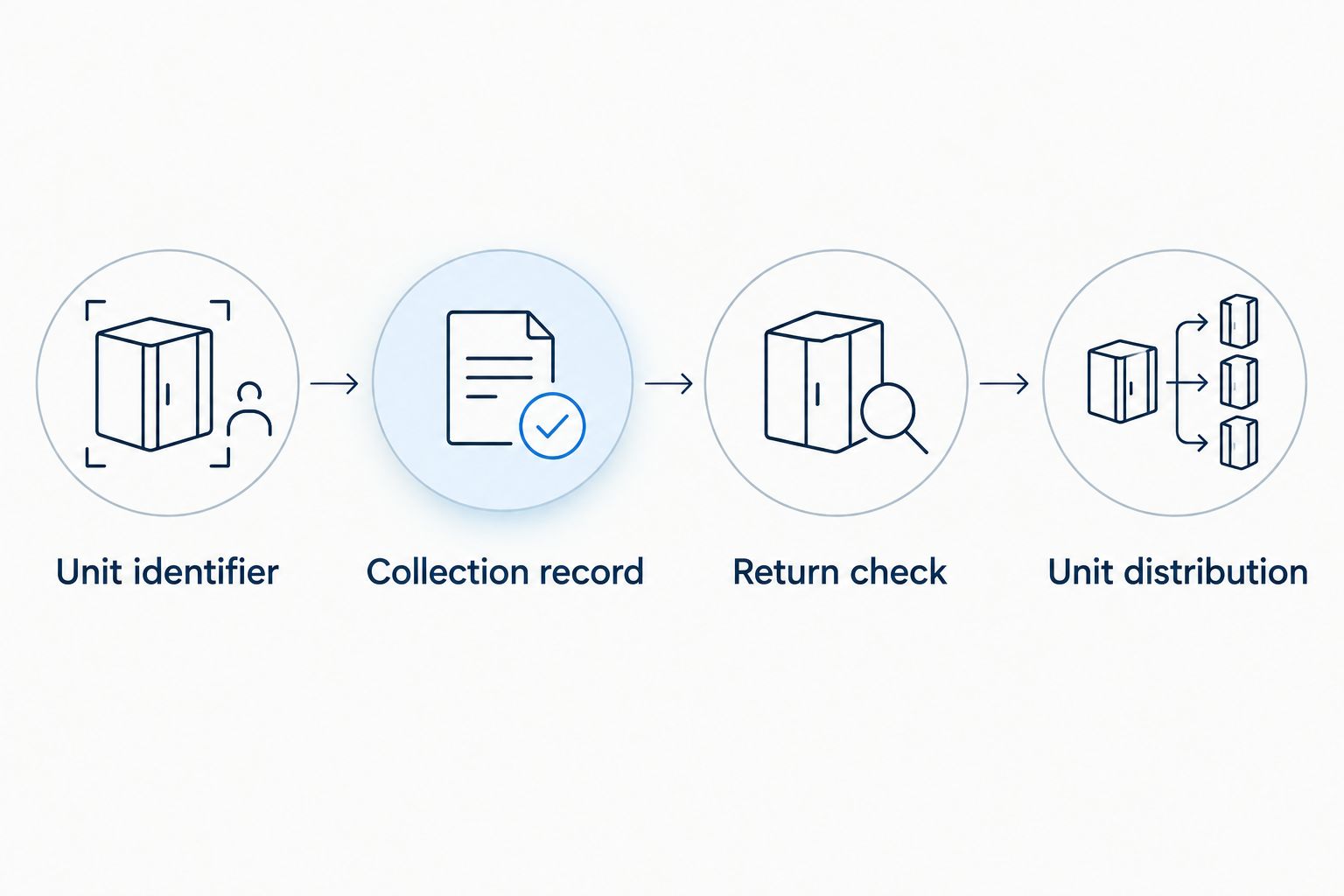
Use a consistent unit-identification method approved by the provider. Match the identifier on the collection record to the identifier used for the return. Do not rely on bag color or staff memory.
For your internal checklist, require 1 unit identifier per household order, 1 designated manager contact per property and 2 handoff checks per collection cycle: departure and return. These are recommended operating controls, not provider requirements or measured service results.
At departure, record what you hand over using the agreed method. At return, check the destinations before staff distribute anything. Keep unrelated resident orders separate unless the provider has explicitly approved a different process.
An identification system also needs a rule for exceptions. Tell staff where to hold an unclear return and whom to contact. Do not send an unidentified order to a resident simply because the contents look familiar.
How should households and business towels share a pickup plan?
Household clothing and commercial towels can appear in the same property inquiry, but keep the service requests distinct. A resident needs personal laundry returned to the correct household; a property business needs towels available for its operation.
Summa Laundry’s wash-and-fold and commercial towel services are best suited to households and local businesses seeking pickup rather than on-site washing. Its stated services fit those needs; any combined multi-unit arrangement still requires direct confirmation.
For households, ask about individual booking, preparation instructions and order ownership. For business towels, describe the use, collection location and proposed recurring routine. Do not promise pooled billing, separate invoices or shared account access until those arrangements are agreed.
Stop making your staff translate a vague request into daily instructions. Send the property brief through the contact page and ask for a confirmed collection and return plan.
Plan your property pickup
Describe your units, laundry types and handoff locations before requesting a schedule.
Can occupied apartments use the same laundry pickup schedule?
Occupied apartments can share a proposed collection schedule when residents, management and the provider agree on the arrangement. Keep each household’s ownership and instructions clear, and confirm whether residents book individually or management coordinates the request.
A shared pickup day is not permission to combine personal laundry. Establish the order-identification and return process first.
Can property managers combine towels from different rentals?
Property managers should combine towels only after confirming the handling arrangement with the provider. If towels must return to specific rentals, preserve those destination identifiers throughout collection and return.
If you manage a shared inventory pool, explain that explicitly. Do not assume the provider will track property-level allocations without an agreed process.
Can collection follow changing move-out dates?
Collection can be requested around move-out dates, but each proposed change needs confirmation. Give the provider the actual ready date and required return date rather than treating a calendar entry as an accepted booking.
Keep usable replacement inventory available for turnover planning. Do not make a guest arrival dependent on an unconfirmed laundry return.
FAQ
Can a property manager book laundry pickup for several units?
A property manager can coordinate a multi-unit pickup request, but the provider must confirm the collection locations, order separation and return arrangements. Do not announce a building-wide schedule before those details are agreed.
Does Summa Laundry automatically combine multiple units into one order?
Do not assume Summa Laundry combines multiple units into one order. Ask how household orders and property-owned towels should be identified, scheduled and returned before booking.
What's the best pickup setup for an apartment building?
Central collection is a practical proposal for a staffed building with an approved holding area. Unit-level pickup is a separate arrangement to request when households need independent handoffs; confirm provider support before choosing.
Can residents keep their laundry separate from shared building towels?
Request separate identification and handling instructions for resident clothing and shared building towels. Confirm the provider’s process rather than assuming collection at the same address means combined handling.
Can I request recurring towel pickup for an apartment fitness room?
You can inquire about recurring commercial towel service for an apartment fitness room. Describe the towels, collection point and operating schedule so the provider can assess the service fit.
Can property managers request pickup in Buckhead?
Buckhead home and business pickup is confirmed by the owner. Send the exact property addresses and proposed handoff details to confirm the multi-unit arrangement.
What should I check before launching multi-unit pickup in 2026?
Before launching multi-unit pickup in 2026, confirm participating addresses, accepted items, unit identification, access, scheduling and return responsibility. Give residents and staff only the instructions the provider has approved.
One last thing
Plan the return before the pickup. A collection location is only half the arrangement; name the person who will receive clean laundry and verify its destination before you schedule the first handoff.
For your 2026 launch, start with a clearly defined participating group rather than announcing service to every unit. Confirm the process with Summa Laundry, then expand only after the handoff instructions work for your property.